Capstone Project 2025/26
AI as an Assistance System for Military Leadership
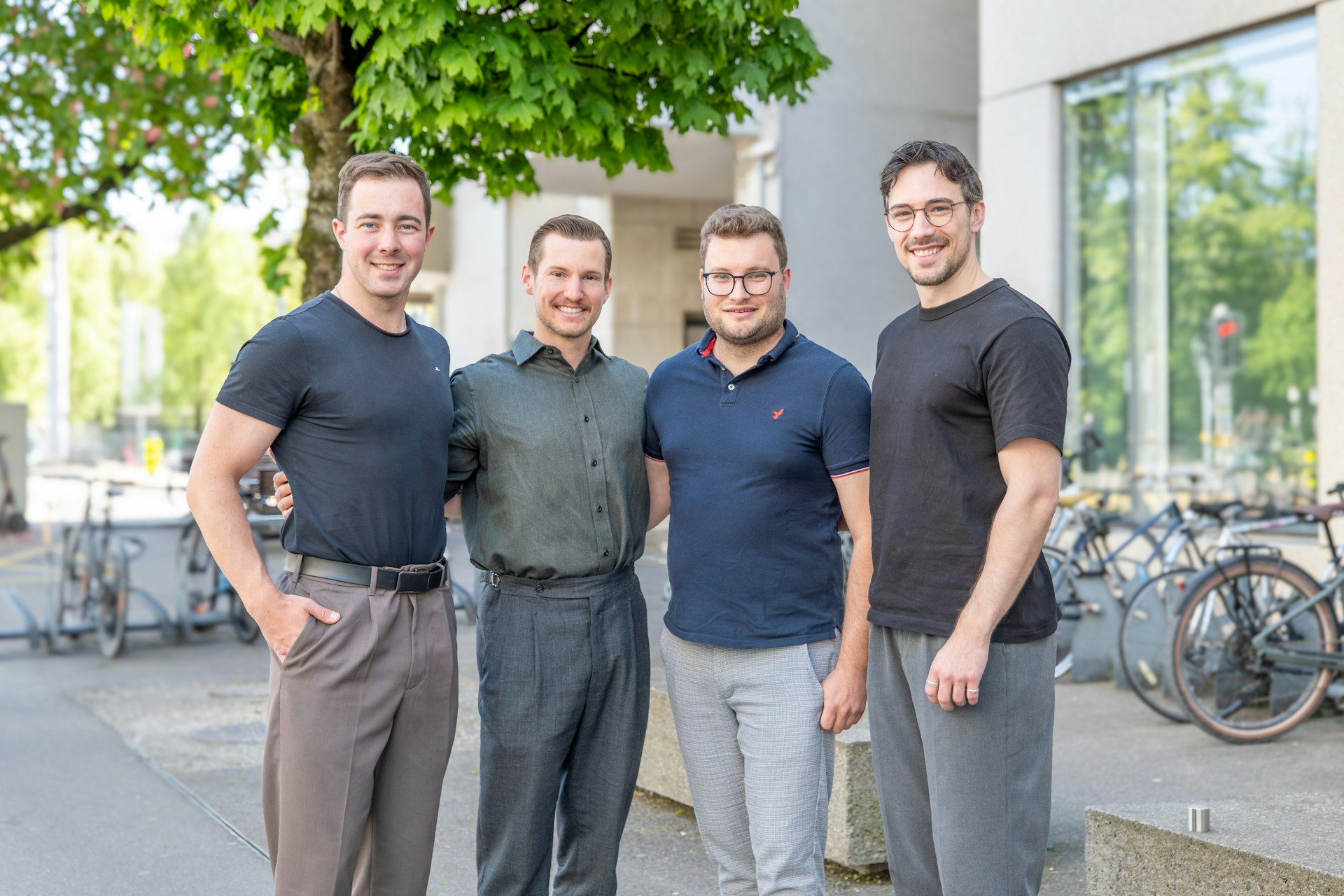
When decisions must be made under significant responsibility, time pressure, and with incomplete information, leadership becomes a real challenge. This is precisely where the 2025/26 Capstone Project «SITRA» comes in: Robin Stalder, Laurent Schürch, Stefan Zellweger and Lars Müller, students of the major Digital Business & AI Management in the HWZ Bachelor of Business Administration, have developed a concept for an AI-based assistance system that supports military leaders in such situations without taking the decision-making process out of their hands.
Campus · May 1, 2026
About the award
The Bachelor of Business Administration programme at HWZ is pleased to announce once again the impressive results of this year’s Capstone Project in the Bachelor of Business Economics. The programme is completed with the major in Digital Business & AI Management at HWZ. As part of this, students are required to develop a business case for the implementation of artificial intelligence within a company. Each year, the best project is recognised with a prestigious award.
Leadership in Times of Uncertainty as a Starting Point
The idea for the project did not arise in theoretical classes, but directly from practical experience. Robin Stalder, a militia officer with the rank of first lieutenant, currently training to become a company commander, and Lars Müller, a sergeant serving as a communications specialist, both regularly experience military leadership in practice themselves.
Both observe in exercises and operations that managers often have to work under extreme time pressure with incomplete, delayed or contradictory situational information. In time-critical military situations, information must be processed quickly, consistently and in a traceable manner. It is usually passed on, filtered and interpreted verbally along hierarchical levels, with the risk of errors in hearing, writing and interpretation increasing at each stage. In the end, the decision-maker receives a fragmented and already filtered picture of the situation, yet must still make important decisions based on this.
The aim: better decision-making, not automated management
As their capstone project, they developed «SITRA», an AI-supported solution that systematically consolidates information and provides targeted support to managers. The project’s objective was deliberately well-defined: not the automation of leadership, but the targeted and measurable improvement of responsiveness, situational consistency, and decision quality through a structured, technologically assisted situational management system.
Specifically, they aimed to demonstrate that AI can be used responsibly and safely in a safety-critical environment. Full decision-making authority was to remain with the military leadership at all times. They began with a careful analysis of the problem and assessment of the situation, focusing on the following key sub-issues: Which steps in the situation management process are particularly prone to error? Where does the greatest cognitive workload arise? Only after this did they begin developing the architecture.
Their approach was deliberately modular and iterative. They worked through four project phases, from clarifying the mandate and developing scenarios to creating a concept for the development of initial prototypes. In doing so, they combined technical expertise gained from their studies with operational military knowledge, consistently focusing both on the user experience of the leadership team.
The solution: «SITRA»
The proposed solution is called SITRA – Situational Tracking & Review Assistant. It is a locally operated, speech-based situational assistance system designed to provide targeted support to military leadership.
At the core is a so-called «world model»: a rule-based, unified information base that serves as a «single source of truth» to represent the current situation. All participants access the same, verified foundation.
Voice commands are first captured using automatic speech recognition (ASR), then interpreted by an LLM-based language understanding module, and finally checked by a deterministic governance gate before being adopted as a state change in the world model. Despite AI support, a human remains «in the loop» at all times. In addition, an immutable event log records all actions for subsequent review (after action review).
The greatest challenges
The greatest challenge was determining how much AI autonomy the four students could and wished to permit in a safety-critical system.
While fully automated systems would have been technically simpler to implement, the real challenge lay in finding the right balance between AI support and human oversight, and in clearly defining this boundary.
At the same time, they must ensure that the system also functions in offline environments, which places considerable demands on local processing.
Another challenge is acceptance: managers who are accustomed to traditional leadership processes must be convinced of a new system, without it calling their authority and decision-making freedom into question.
Learnings from the degree programme
The degree programme prepared us for the project in several ways. The students were able to apply the technical fundamentals of AI, natural language processing, and system architecture directly – particularly when designing the LLM-based NLU module and the deterministic state engine.
The expertise in change management and value design was crucial in developing the solution not only from a technical perspective, but also with the user in mind. Ultimately, our studies taught us to approach complex problems in a structured manner.
The main lesson learned from the project:
Responsible use of AI requires more design effort than full automation. It is simpler to allow an AI to make all decisions, rather than implementing it as an assistive system with defined boundaries. Especially in safety-critical contexts, humans must be able to understand, question, and reject system recommendations.
This insight is not only relevant in military contexts, but also for many other applications involving critical AI systems.
What are the next steps for the project?
The project is being advanced in collaboration with the Swiss Innovation Forces of the Swiss Army. The idealisation stage of the five-phase process has been completed and is now moving into the validation phase. If the feasibility of the project is assessed as practical and value-adding through the use of prototypes and specialist interviews, it will proceed to the experimentation phase.