The Department of Banking & Finance, Controlling and Real Estate
The MSc programme in Banking & Finance at HWZ is your gateway to the future of banking: practice-oriented, innovative and international. You will acquire skills in asset management, digital transformation and sustainable strategies to actively shape the financial industry. Thanks to its flexible structure, you can combine your studies with up to 90% employment.
Apply
Master of Science (MSc) in Banking & Finance HWZ
Designed to accommodate employment of up to 90% (minimum 50%)
Mid-September (calendar week 38)
CHF 7,900 per semester
4 semesters
The language of instruction is German.
Curious about this course? Join us in person or online to learn more about our programmes and study options. We look forward to welcoming you.
The MSc Banking & Finance HWZ is aimed at professionals in the financial sector who wish to combine digital skills with regulatory expertise.
In this part-time master’s programme in financial management, recognised industry experts and academically qualified lecturers provide up-to-date knowledge. The programme combines online and on-campus formats to offer the best learning outcomes and flexibility. In five consecutive online sessions (each consisting of four evening classes), core content on various topics is delivered in an interactive and structured manner, supplemented by instructional videos and regular learning assessments that enhance the study experience and consolidate knowledge. The material is divided into easily digestible units, improving retention and optimising the learning effect.
After acquiring knowledge during the online phase, you will move on to developing your skills in practice-oriented workshops. For that purpose we meet four times per semester for intensive three-day workshops, where you will apply, present and reflect on your knowledge using live cases, team challenges and case studies. These mini bootcamps ensure that you consolidate your new knowledge and can apply it directly in your own professional environment.
This programme is aimed at ambitious, high-achieving young professionals who hold a bachelor’s degree, have three to five years of work experience, and who are already actively employed in the financial sector. Participants are expected to be willing to develop further in a demanding environment while maintaining a balance between their professional responsibilities and intensive further training.
This MSc programme equips you with the ability to combine the traditional strengths of Swiss banking – management and client-centred advisory services – with modern technologies. Banks and financial institutions must continue to evolve, understand technological opportunities, and make targeted use of them without neglecting their traditional business. Students learn how financial markets operate and how to make well-informed investment decisions. The programme thus bridges the gap between traditional banking and contemporary leadership and innovation concepts.
Your learning journey is structured around both established and emerging challenges and is divided into four semesters.
The Foundations of Banking & Finance module is of key importance, as it provides students with a solid understanding of the fundamental mechanisms and instruments of the financial market. It covers topics such as quantitative analysis and the concept of the time value of money, both of which are essential for making informed decisions. Students learn how to make capital allocation decisions, enabling them to distribute resources efficiently and maximise company value. In addition, they acquire knowledge about calculating the cost of capital, which is crucial for business valuation.
Example topics in this module:
Risk/return of financial markets
Time value of money
Quantitative analysis
In financial planning and cash flow analysis, precise forecasting skills, a thorough understanding of liquidity flows, and the correct application of financial ratios are essential. For investment calculations, sound knowledge of valuation methods and the ability to account for uncertainties through scenario analysis are required. In the field of corporate finance, the focus is on strategic decision-making, managing capital structure, and analysing company value.
Example topics in this module:
Methods of business valuation
Financial forecasting
Corporate finance
Financial modelling skills are essential for a career in finance. For example, students develop a dashboard and valuation tool for a listed company in order to make informed investment decisions. The course strengthens Excel skills and imparts practical modelling expertise, which is demonstrated in a final presentation.
The first part of the semester provides a comprehensive introduction to the world of wealth and portfolio management, equipping students with the skills necessary to develop and implement individual investment strategies. Building on Markowitz’s theories, modern portfolio management has evolved further. For example, ESG integration now plays an important role in portfolio construction. Another focus is on international wealth management, where global investment opportunities and legal frameworks are taken into account. Finally, students develop skills in simulating wealth forecasts, enabling them to make informed decisions about future asset performance and to minimise risks.
Example topics in this module:
Modern portfolio theory
International wealth management
ESG integration
In the second part of the semester, we broaden our understanding of portfolio management by examining new investment instruments such as private equity, venture capital, and cryptocurrencies, which are increasingly being incorporated into client portfolios. Using our own backtests, we analyse how these alternatives affect the risk-return profile of traditional portfolios. We also consider the role of financial derivatives in risk diversification: how can derivatives and structured products be used strategically? Engaging with derivatives, regarded as a premier discipline in financial instruments, constitutes an intellectual challenge and deepens students’ knowledge in this complex area.
Sample topics in this module:
The new alternatives
Financial risk management
Certificates and structured products
Over the course of the semester, students create a hypothetical investment portfolio tailored to the individual needs of a client. Assessment is based on their ability to meet client requirements and make well-founded decisions, as well as on the regular monitoring and analysis of portfolio performance using appropriate key figures. In their final task, students present an analysis reflecting on the portfolio’s performance, the extent to which client needs have been met, and the quality of their decisions.
In the third semester, we push the boundaries of modern banking, focusing on open banking, robo-advisory and digital wealth management, as well as digital assets and blockchain. Open banking enables customers to manage their finances more transparently and efficiently. Robo-advisory and digital wealth management provide personalised and cost-effective investment solutions through automation. These developments are creating new business models and ecosystems for financial institutions. Students with expertise in these areas secure a competitive advantage and open up a wide range of career opportunities.
Example topics in this module:
Open banking
Robo-advisory
Digital wealth management
As the semester progresses, we will delve deeper into the world of technology and artificial intelligence within the financial sector. Few other service industries have experienced such significant technological advancement in recent years as the financial industry. Today, technology is an indispensable part of business models and is increasingly permeating all areas of banking processes. Artificial intelligence holds the potential to fundamentally change the way financial institutions operate in the long term – from investment strategies to fraud prevention. In a three-day practical bootcamp, we will implement real-world use cases and develop our own programmes.
Sample topics in this module:
Basics machine learning & AI in Finance
Use cases of AI in finance
Bootcamp: Python programming
As part of their practical work, students apply big data, Python, and artificial intelligence in the field of finance. They develop practical skills in financial analysis, modelling, and algorithmic trading. Through practice-oriented tasks, they learn how to construct financial models and solve market problems efficiently.
In the final semester, we analyse how banks can strengthen their market position and build closer relationships with their customers. We examine new business models and strategies that banks require for successful positioning. Given the growing significance of fintechs, the capacity for innovation within banks is becoming increasingly decisive. Traditional banks often find it challenging to integrate new technologies rapidly, which has led to increased cooperation with fintechs. We will explore why banks have difficulties with innovation, what obstacles exist, and how fintechs can be integrated into traditional business models.
Example topics in this module:
Innovation & trends in finance
Embedded finance & fintech
Study tour
Each semester comprises two to three modules, each of which is completed with an individual assessment. Typical forms of assessment include written and online tests, short presentations, and case studies. In addition, you will work in a team to complete three practice-oriented transfer projects, which together replace the master's thesis and lead to the MSc degree. These transfer projects, which promote the practical application of knowledge, are awarded a total of 20 ECTS credits.
The following admission criteria apply to the MSc in Banking & Finance HWZ. If you have any questions please do not hesitate to contact us for further clarification.
Bachelor’s degree
3 – 5 years of professional experience
No 'sur dossier' admissions
For holders of a diploma from a college of professional education (höhere Fachschule - HF): at least 90 of the 180 ECTS credits required for a bachelor's degree must be completed at an accredited university of applied sciences or university.
Designed to accommodate employment of up to 90% (minimum 50%)
Master of Science (MSc) in Banking & Finance HWZ
90 ECTS credits
24 - 28 Teilnehmende
Primarily synchronous teaching, supplemented by online sessions (see coursedata)
Bachelor’s degree | 3–5 years of professional experience | No 'sur dossier' (individually assessed) admissions | For HF graduates: at least 90 of the 180 ECTS credits required for a bachelor’s degree must have been successfully completed at an accredited Swiss university.
Mid-September (calendar week 38) The 2026 programme is fully booked – only waiting list places are available.
4 semesters
Per semester: - 15 input sessions of 4 lessons each (online, every Tuesday evening) - 4 workshops of 3 days each (Thursday / Friday / Saturday) Input sessions and workshops do not take place in the same week.
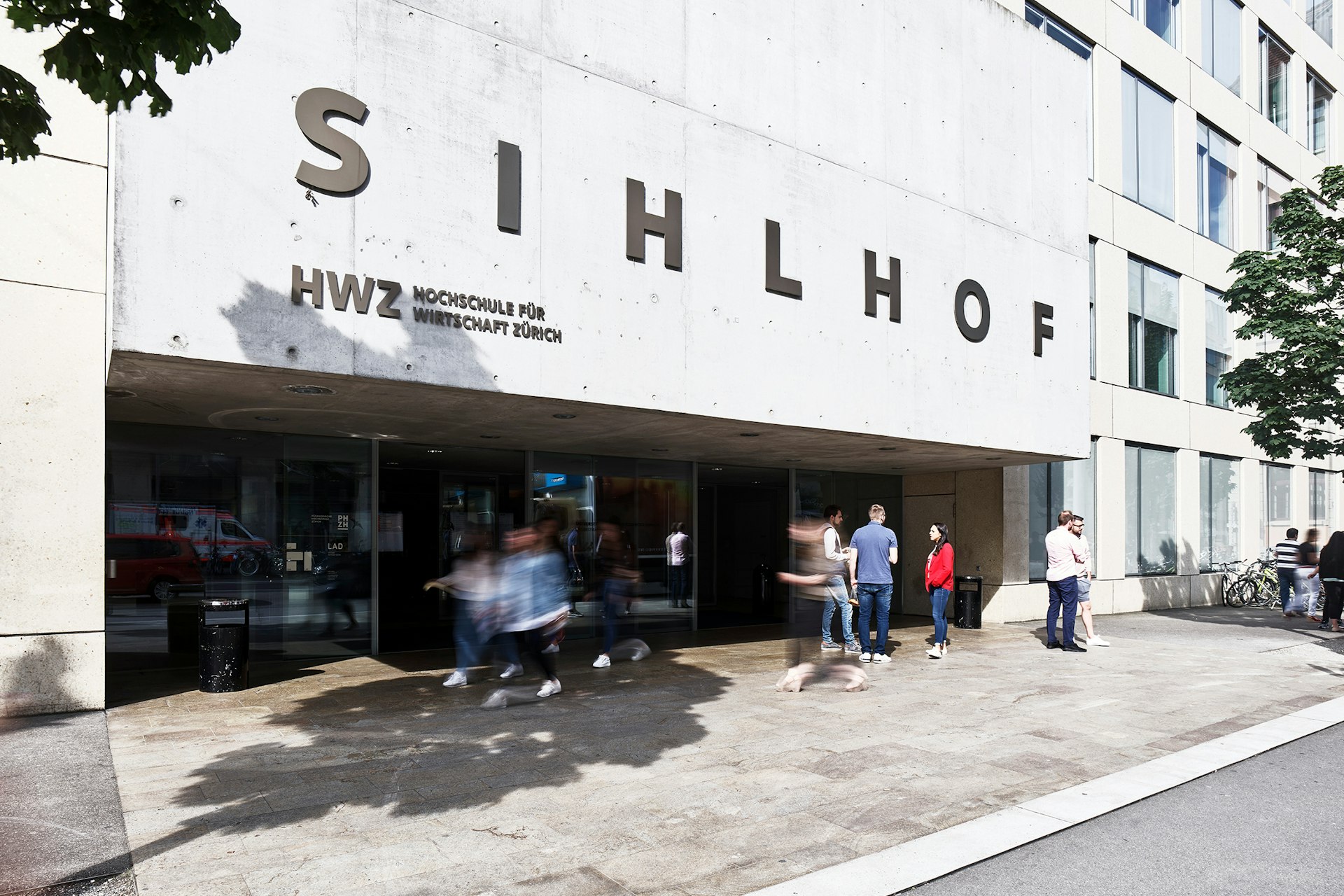
Zurich; Sihlhof (directly by the main station)
Tuition fee CHF 7,900 per semester (all-inclusive, except for flights and accommodation for the study trip).
We look forward to meeting you. We would be pleased to provide you with personal information about this degree programme.
The Department of Banking & Finance, Controlling and Real Estate

Comparison of AI executive education programmes

HWZ Summer Day Party
Annual Report 2025