


The Department of Management & Leadership
In the MSc in Business Administration – Major in Digital Strategy, you will learn how to transform an organisation into a truly digital powerhouse. This programme provides a structured and practice-oriented learning journey, focusing on the key drivers of successful digital transformation. At the same time, you can continue to advance your career, as you are able to work up to 90% alongside your studies.
Apply
Master of Science (MSc) in Business Administration HWZ with a major in Digital Strategy
Designed to accommodate employment of up to 90% (minimum 50%)
September
CHF 7,900 per semester
4 semesters
The language of instruction is German.
Curious about this course? Join us in person or online to learn more about our programmes and study options. We look forward to welcoming you.
The MSc in Business Administration HWZ is aimed at professionals who wish to combine in-depth management knowledge with digital and economic expertise.
In the MSc in Business Administration, teaching is delivered by practitioners who are also qualified both academically and in teaching methods.
The course design has been structured so that, over five consecutive online input sessions (each comprising four classes) held in the evenings, various topics are covered. The primary aim of these sessions is to generate new knowledge. Online teaching is particularly well suited to interactive knowledge transfer and also increases your flexibility. We divide the content into easily digestible segments. This approach enhances memory retention, improving the learning effect.
After you have acquired knowledge on a specific module topic, the subsequent workshops focus on applying this knowledge. This marks the phase of skills development. In this phase we meet four times per semester for three-day workshops. During these sessions, we work on activities such as live cases, team challenges or case studies, and engage in presenting, discussing and reflecting. After these mini bootcamps, you will have internalised the topics to such an extent that you can immediately apply your newly acquired skills within your business.
The MSc in Business Administration with a major in Digital Strategy is designed for curious, energetic and open-minded managers who hold a bachelor’s degree. It is important that you already have three to five years of professional experience and are currently employed.
Complete the MSc in Business Administration, Major in Digital Strategy at HWZ now also in Bern – with the same quality, content and degree.
You will study within the official MSc programme at HWZ. Classes in Bern take place at the PHW campus (located next to the Wankdorf Stadium).
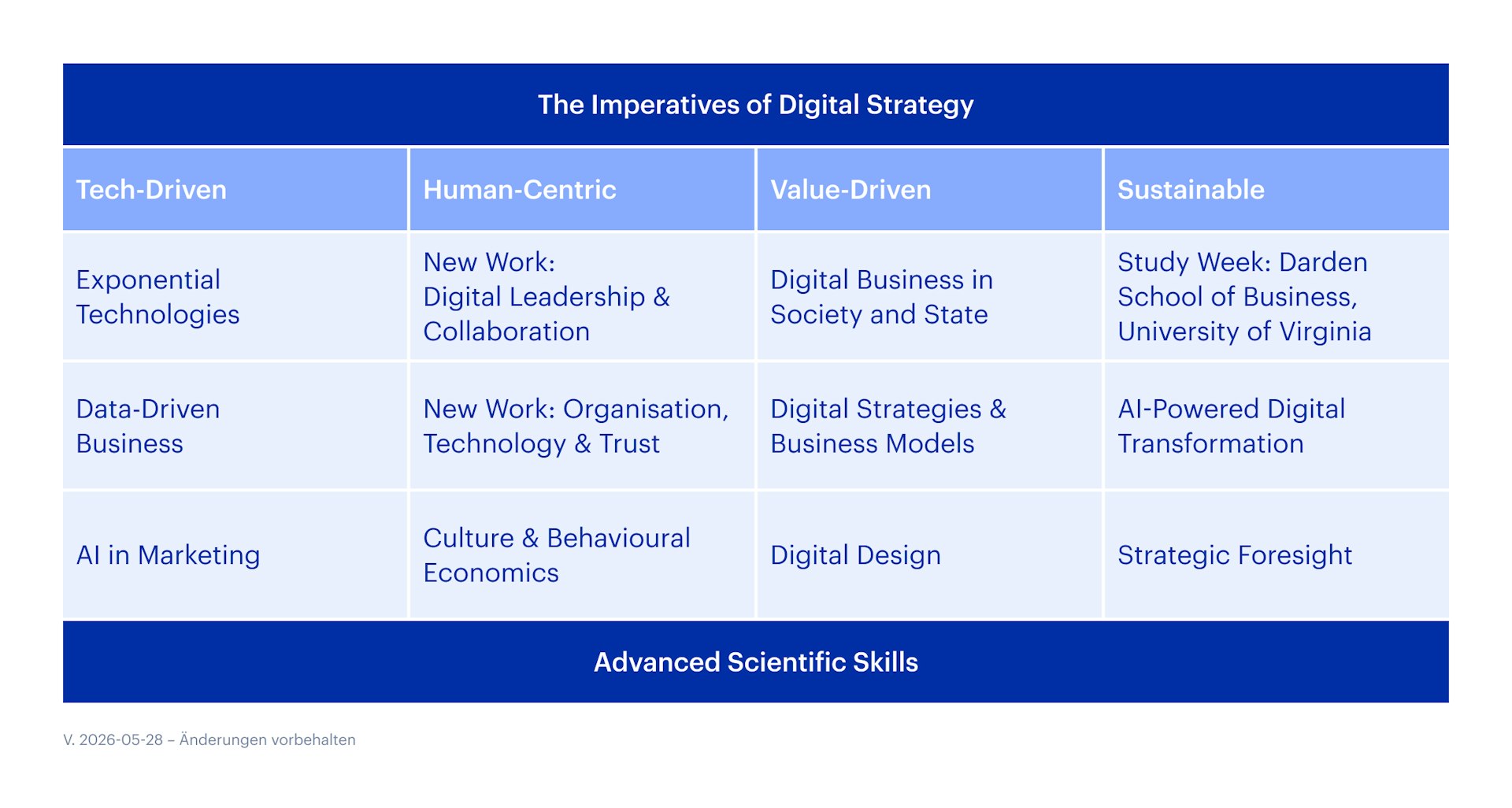
The technological developments of the digital age are opening up new opportunities for businesses. In the MSc Business Administration - Major in Digital Strategy, you will learn the fundamental principles that help organisations to harness the benefits of these new developments. To do so, companies must reconsider and realign the following areas in order to develop a compelling and coherent digital strategy:
The use of new technologies (tech-driven)
The definition of the human role within the organisation (human-centric)
The business and value creation logic (value-driven)
Economic, social and ecological sustainability (sustainable)
Exponential technologies accelerate change through enhanced computing power, bandwidth and data storage. The exponential growth of technologies will result in interactions between different technological subgroups, creating new business opportunities. Early computers had such limited power that the initial doublings in computing performance had little impact. However, the doubling of computing power has continued steadily. This can be illustrated by the legend of the chessboard and the grains of wheat: If you start with one grain on the first square of the chessboard and double it for each subsequent square, the total amount of grain is initially quite modest. This changes once the second half of the chessboard is reached. In the second half, the exponential growth becomes significant. By the 64th square, the amount of wheat grains is 703 billion tons. Technologically, we are currently in the second half of the chessboard.
Sample topics in this module:
Artificial intelligence / machine learning
Cloud computing
Blockchain
Data is the most important asset of a digital enterprise. Artificial intelligence (AI) is a foundational technology – comparable to the steam engine, electricity or the internet – that enables this data to be utilised. This means that the use of AI in business environments will continue to increase. In addition, applications will improve exponentially while also providing the basis for further innovation. The challenge for organisations lies in not simply applying these new technologies to existing business logic. In the past, foundational technologies have only made companies successful when they have understood how to translate the unique features of these technologies into new business processes and models.
Sample topics in this module:
Big data
Hyperautomation
Robotic process automation
Do we really know who our customers are and how they behave? Unless we can answer this question with certainty, we cannot create an outstanding customer experience. We must make effective use of the information available to us. This enables us to take the effectiveness of marketing to a new level. Data and algorithms support us in this process. For the first time, companies have the opportunity to systematically embed customer orientation within their organisation, rather than leaving it to chance – that is, just to a human.
Example topics in this module:
Customer lifecycle and customer journey models
Performance marketing, personalisation, ethics and data
AI marketing canvas
In organisations where decisions are increasingly based on data and evidence rather than the HIPPO principle (highest paid person’s opinion), a new understanding of leadership is required. We are witnessing a shift in leadership from the ‘Great Man’ to the ‘Great Team’ approach. The era of heroic leadership (the ‘Great Man’) is over, as it disregards the collective intelligence of people and new technologies. We will examine what this means for different levels of leadership (individual, team, system) and which leadership approaches hold the promise of success in the era of digitalisation.
Example topics in this module:
Humble leadership
Shared leadership
Complexity leadership
Digital transformation and disruption, Taylorism 4.0, or the automation of leadership – the list of buzzwords associated with New Work could be extended many times over. Despite this variety of terms, all these trends are ultimately concerned with better understanding the relationship between technology and people in the workplace. New technologies are changing both how we work and how work is organised. For New Work to succeed, it is essential to address these pressing questions. For example, how does technology influence employees’ mindsets, or what can organisations do to prevent employees from being reduced to mere data subjects or limbs of the machine? Resilient and agile organisations require a strong culture of trust. How can such a culture be established, and how can we resolve the tensions between the efficiency demands of technology and the need for freedom to make mistakes, learn, and be creative? Ultimately, dealing with technology in the workplace also raises ethical issues, namely the role of the employee in a technology-driven company and how it can be credibly lived and promoted.
Example topics in this module:
Technology in the service of humanity
Humanistic workplace
Technology and trust
Every organisation has its own culture. The key question is whether this culture supports the implementation of the desired strategy or whether it actually hinders it. A culture creates a sense of identification for employees, customers and suppliers. Many companies in the new economy cultivate their corporate culture very deliberately and strategically. They recognise that this can be a unique competitive advantage that cannot be imitated. We shape organisational culture through our values, norms and behaviour. It is no longer surprising that our behaviour is not always rational. The situations in which people act irrationally and hence emotionally are currently being researched at a breathtaking pace. Understanding how people think allows us to understand and respond to them better. But the journey doesn't end there: Behavioural Economics is the alchemy of perfect user experiences and optimized conversion rates.
Example topics in this module:
Competing values framework
Nudging
Prospect theory / cognitive biases
Technological change is having a significant impact on our society. On the one hand, there is an ongoing technological arms race between the US and China. It is important to understand the objectives pursued by these major powers and what this means for businesses. On the other hand, the central role of predominantly personal data in new business models raises important questions about how such data is handled. How can companies work with this data and ensure that it generates benefits for society? Issues of regulation must be reassessed and discussed. The goal must be to optimize both the social and economic benefits of technological advancement.
Sample topics in this module:
Geopolitical situation: USA vs. China
Regulation
Corporate digital responsibility
Traditional approaches to strategic management, which define the sectors in which a company should operate and how it can position itself within its respective business areas, are increasingly reaching their limits. This is because competition now extends beyond traditional industry boundaries. When the introduction of new value propositions influences competition across sectors, blurs boundaries and overturns established structures, this is referred to as disruption by ecosystems. Ecosystems follow their own logic and appear in various forms (for example, platform ecosystems). In the past, companies used expensive facilities to manufacture physical products. Digital companies, on the other hand, don't always need to own physical assets to make money. Historically, companies also focused heavily on internal resources. Now, they are discovering the advantages of a vast, global, digitally connected pool of talent. In many cases, collective intelligence surpasses internal expertise.
Sample topics in this module:
Ecosystems
Platforms
Open Strategy
To understand new technologies, you must put them to the test. Only then can groundbreaking products and services emerge. These experiences are further enriched by knowledge of design methods and tools. A deeper understanding of design enables you to align technology with human needs. Technology is not an end in itself: it should serve humanity. This module is delivered in collaboration with Zurich University of the Arts.
Design methods and tools
UX design
FabLab
The Darden School of Business is ranked among the top 10 business schools worldwide. It is renowned for its exclusively case study-based teaching approach. During this week, critical thinking, creativity and problem-solving skills are developed through illustrative case studies, delivered in a typically American style that is both engaging, entertaining and academically rigorous.
Sample topics in this module:
Digital business models
Strategic thinking
Creating value for stakeholders
Innovation is a reflection of adaptability. Only those who continually reinvent themselves can remain competitive. Ultimately, innovation is a matter of numbers. The company with the largest innovation ecosystem has the greatest chance of achieving a breakthrough. The likelihood of a major success increases with the number of attempts. It’s that simple. Or is it?
Sample topics in this module:
Innovation ecosystems
Trend management
Innovation processes and culture
A strategy is always subject to increasingly shorter life cycles. One way to keep the momentum in strategy development high is through a hackathon. This format is no longer used solely in software development, it has also found its place in strategic management. Strategy hackathons are well suited to addressing one of the most pressing questions of our time: how can we, as a company, operate sustainably?
Sample topics in this module:
Circular economy
Organisational identity
Strategic mindset
The aim of science is to generate new knowledge and insights, and to do so in a systematic and transparent manner. Those who are able to work scientifically gain a better understanding of cause and effect. Suddenly, vast amounts of data begin to make sense. With today’s information overload, scientific skills help individuals to find their bearings and to distinguish what is relevant from what is not. Scientific thinking enables people to view the world from multiple perspectives. It has been proven that this leads to greater success in a business environment.
Example topics in this module:
Paper-writing workshop
Scientific thinking
Handling data
The well-structured programme, combined with a high-calibre and diverse class composition, ensured that I was able to gain the maximum benefit from the MSc. For me, the main reason for this was the discussions with the lecturers as subject experts, rather than one-sided knowledge transfer.
Bachelor’s degree
3 – 5 years of professional experience
No 'sur dossier' (individually assessed) admissions
For holders of a higher vocational diploma: at least 90 of the 180 ECTS credits required for a bachelor's degree must be completed at an accredited university of applied sciences or university.
Tuition fee CHF 7,900 per semester (all-inclusive, except for flights and accommodation during the study trip)
Excludes flights (approx. CHF 600–900, depending on route/fare) and accommodation / half board (CHF 1,200) for the one-week International Management Programme at the Darden School of Business.
Designed for employment of up to 90% (minimum 50%)
Master of Science (MSc) in Business Administration HWZ with a major in Digital Strategy
90 ECTS credits
24 - 28 Teilnehmende
Primarily synchronous teaching, supplemented by online sessions (see course data)
Bachelor’s degree | 3–5 years of professional experience | No 'sur dossier' (individually assessed) admissions | For HF graduates: at least 90 of the 180 ECTS credits required for a bachelor’s degree must have been successfully completed at an accredited Swiss university.
Mid-September (calendar week 38)
4 semesters in 2 years
Per semester: - 15 input sessions of 4 classes each (online, Tuesday evenings) - 4 workshops of 3 days each (Thu/Fri/Sat) Input sessions and workshops do not take place in the same week.
Zurich; Sihlhof (directly by the main station) Bern; Private University of Applied Sciences PHW Bern, Max-Daetwyler-Platz 1, 3014 Bern
Tuition fee CHF 7,900 per semester (all-inclusive, except for flights and accommodation during the study trip) Excludes flights (approx. CHF 600–900, depending on route/fare) and accommodation/half board (CHF 1,200) for the one-week International Management Programme at the Darden School of Business.
We look forward to meeting you. We would be pleased to provide you with personal information about this degree programme.
The Department of Management & Leadership

Guest article by Lea Hungerbühler

Comparison of AI executive education programmes

How further education opens up new perspectives