Innovation from the CAS
Innovation from the CAS: Thierry Berger develops the Level Up Pass for padel
What began as a spontaneous practical project in the CAS Marketing Strategy course has become a real success story for Thierry Berger: today, at Padel District, he is not only responsible for implementing his own marketing strategy, but has also created the "Level Up Pass"—a product that is attracting attention far beyond the club itself. In this interview, he discusses why strategy only truly emerges in practice, and why, for him, the combination of study and hands-on experience is the key to genuine innovation.
Testimonial · March 23, 2026
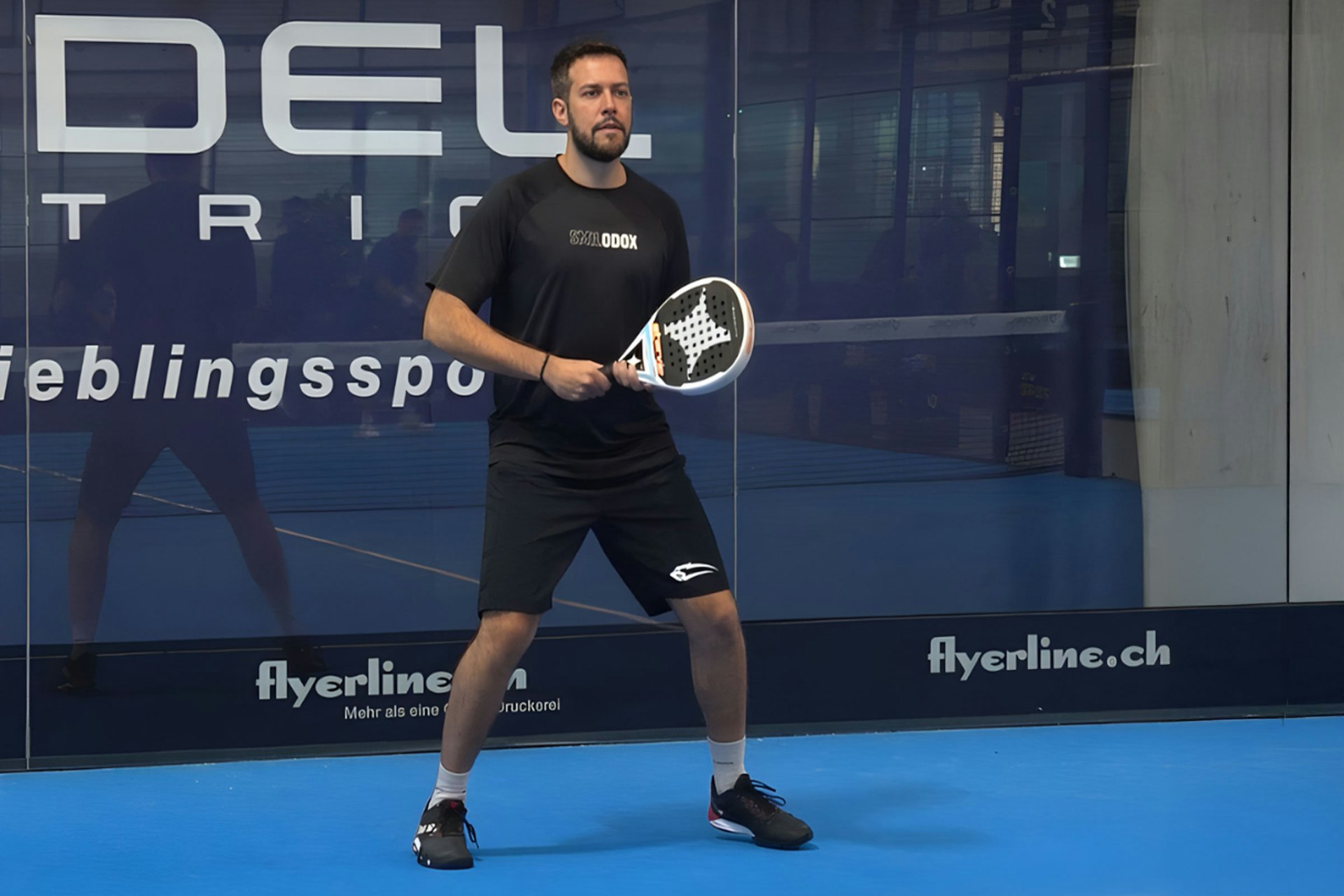
Your project in the CAS Marketing Strategy is a wonderful example of how theory is applied in practice. For Padel District, a relatively new padel club, you have developed a marketing strategy which you are now able to implement in a part-time role alongside your main occupation. How is the implementation progressing, and where do you notice differences between strategic theory and operational reality?
The marketing strategy arose quite by chance: I was with friends at the opening of the first Padel District hall in Pfäffikon and was immediately fascinated by the world’s fastest-growing sport. Shortly afterwards, I needed a practical project for the CAS Marketing Strategy HWZ. So I took a chance and wrote to the founders. We did not know each other, and my enquiry was straightforward: I would develop a marketing strategy and, in return, receive in-game credit. The strategy was ultimately so well received that it led to a part-time role, which I still hold today.
When we began to test individual ideas from the strategy within the club, the difference between theory and practice quickly became apparent. For example, I had suggested integrating a co-working space in the hall so that people could first hold a meeting and then play padel together afterwards. On paper, this sounded plausible. However, a survey within our community soon revealed that there was virtually no interest in this idea. As a result, the project was never implemented.
This experience has shown me that strategy is not a finished plan. It only works if you continually align it with reality and are prepared to abandon ideas when necessary.
The idea for the Level Up Pass emerged during the CAS AI-powered Customer Experience Management, where you were recognised as the top student in your class. How did this idea come about, and what, in your view, makes the Level Up Pass so innovative?
The idea arose from an observation made during everyday club life. Especially in summer, some courts remain unused in a hall during the day, as the lake or the outdoor pool also attract people when the weather is good. At the same time, I noticed that many players had more time available during the summer holidays and were looking for more than simply booking a court.
The Level Up Pass brings these two aspects together. For 99 days, players receive additional benefits for CHF 99. On weekdays, they can play for free before 5 p.m. and simultaneously collect points for their matches. This creates a level system ranging from rookie to legend, making progress visible and providing further incentives.
It is not only the concept that is innovative, but also the technical implementation. Using the API interface of the booking platform, I retrieved the play and booking data of the pass holders and developed my own logic system, which automatically calculates points and a Ranking created.
Before the launch, we held a promotional week. I was convinced that most interested people would purchase their pass during this phase. In fact, the opposite happened. The majority of sales only took place once the pass was already active. This showed me how quickly word spread about the experience in the club. Several players wrote to me afterwards to thank me, saying that through the pass they had found new playing partners, played more frequently, and enjoyed the level rewards. Many still wear the Level Up Pass hoodie today and feel a strong sense of identification with the club.
You say that the Level Up Pass clearly sets Padel District apart from the market and has even been recognised by the Swiss Padel Association. What gap does this product fill, and why is it so successful?
Many sports-related offers operate either through traditional subscriptions or short-term discount promotions. The Level Up Pass takes a different approach: it combines what the club needs with what the community truly wants.
The points system helps us to manage demand in a targeted way. For example, bonus points provide an incentive to play early in the morning or late in the evening, to use the courts during the day on weekdays, to attend training sessions, to meet new playing partners, or to make use of both locations. Each person progresses individually. As a result, this creates less of a traditional competition between individual players and more of a community that motivates one another and improves together.
I was particularly pleased that this concept was recognised beyond the club itself. The Swiss padel association SUIPA featured the Level Up Pass as an innovation in its newsletter.
What does this innovation mean to you personally, and how did those close to you respond to your idea?
For me, the Level Up Pass above all demonstrates how powerful ideas can become when developed together with the community. Many elements did not originate at a desk, but rather emerged from conversations in the club and from the feedback of our players.
The best moment is when you realise that a concept truly works in everyday life. When players compare their scores or strive for the next level, you can immediately see that the idea is alive.
My personal circle has followed the project with interest from the very beginning. Some friends now have a Level Up Pass themselves and have become part of the community.

In your LinkedIn post last autumn, you announced a winter edition of the Level Up Pass. Could you tell us how it went?
Very good! Ninety-eight people took part in the first session held in the summer. The winter edition already attracted 214 participants. This showed us that the concept spread very quickly within the community.
In total, more than 17,000 points were collected and over 5,900 hours played via the Winter Pass. By comparison, during the first run in the summer, there were 7,758 points and 3,005 hours of play. Such developments do not arise from a concept, but from the community itself.
After completing your Bachelor’s degree in Business Communications, you returned to HWZ for the MAS in Marketing Excellence. What motivated you to continue your journey at HWZ and to delve even deeper into marketing?
After the Bachelor in Business Communications HWZ I felt that I was already doing many things intuitively in my professional life. However, I also wanted to gain a better understanding of the mechanisms behind them: why do certain ideas work, while others have no effect?
The MAS Marketing Excellence HWZ gave me the opportunity to pursue precisely these questions directly at Padel District. I was able to test and further develop much of the content immediately at the club. It was exactly this combination of theory and real-world application that motivated me to continue my journey at HWZ.

In your master's thesis, you build on the knowledge you have acquired and investigate data-driven pricing incentives to improve the utilisation of off-peak periods with the help of an AI-automated pilot. What are your key findings from your research?
I investigated how to make better use of short-notice available court slots in order to simultaneously increase occupancy, revenue, and net profit. The study therefore tests so-called flash courts: slots that become available at short notice are offered less than 24 hours before the start of play, with a moderate discount and deliberately only outside of peak times.
The analysis reveals several interesting effects: additional demand is generated by spontaneous players, while those who prefer planning certainty continue to book early. At the same time, the reference price remains stable because prime time is excluded from the offer.
You emphasise that AI does not replace creativity, but rather enhances it—provided it is used correctly. In your projects, where have you specifically experienced AI enhancing creativity?
I use AI as a sparring partner. Depending on the task, I work with different tools. Some help me to understand content more quickly, while others support me with programming or data analysis. The creative idea still originates with the human. AI is particularly useful for viewing an idea from various perspectives and for further developing possible solutions.
For example, with the Level Up Pass, I used AI to develop various logics for the points system and to consider which incentives might genuinely motivate players. This led to different approaches that I might not have come up with on my own straight away.
AI also played a role in my master's thesis. It helped me to analyse large volumes of data from the booking system and to identify patterns in booking behaviour.
You have repeatedly demonstrated how you translate study content directly into marketable solutions. What makes HWZ, for you, a place where such innovation can emerge?
For me, it was crucial that I could apply much of the content directly in practice. The projects from my studies did not remain theoretical but became real experiments at Padel District.
In the CAS Marketing Strategy HWZ this provided the strategic foundation for the further development of the club. The Level Up Pass evolved in the CAS AI powered Customer Experience Management HWZ and today my master’s thesis is testing a real price intervention in ongoing operations. This connection is what makes the difference. Ideas are not only discussed, but actually put into practice. It is precisely this opportunity that has made HWZ a place where innovation can truly emerge for me.
Looking at your journey, it is clear that you actively seek out and make use of opportunities. What motivates you personally, and what advice would you give to students who wish to connect theory more closely with practice?
What drives me most is not only the desire to understand things, but also to help shape them. Many ideas would never have come about if they had remained confined to academic study.
My advice to students is therefore to seek out real-world contexts where their ideas encounter resistance. And my advice to employers is to allow for such friction. After all, innovation rarely emerges where everything is neatly planned, but rather where people are permitted to think beyond the obvious.