From law to identity
How the University of Applied Sciences Act has shaped HWZ
The 1990s marked a turning point for the Swiss educational landscape and for HWZ. With the introduction of the Universities of Applied Sciences Act, not only was a new type of higher education institution established, but also the foundation was laid for HWZ’s current positioning as a practice-oriented, entrepreneurial university.
40 years of HWZ · June 4, 2026
- Seven universities of applied sciences as the new structure of Switzerland
- The transformation: from HWV to University of Applied Sciences
- Practical relevance as a strategic response
- Quality and accreditation: from aspiration to obligation
- Private yet systemically relevant
- Conclusion: 40 years of HWZ – a story of adaptation and integrity
- FAQ
- Sources & further information
This article is part of the content series marking the 40th anniversary of HWZ. Through this series, we aim to showcase the wide range of stories from our university, as well as the topics and individuals that have shaped, and continue to shape, HWZ.
At the beginning of the 1990s, Switzerland faced a fundamental challenge: its education system was difficult to compare internationally and no longer met the requirements of an increasingly globalised economy.
With the Universities of Applied Sciences Act (FHSG) of 1995, the federal government created a new type of higher education institution. Universities of applied sciences were established as the third pillar of the higher education system – alongside universities and the Swiss Federal Institutes of Technology (ETH). Their mandate was clearly defined:
practice-oriented education
Continuing education
applied research
Services for Business and Society
This has created a system that systematically links academic theory with professional practice.
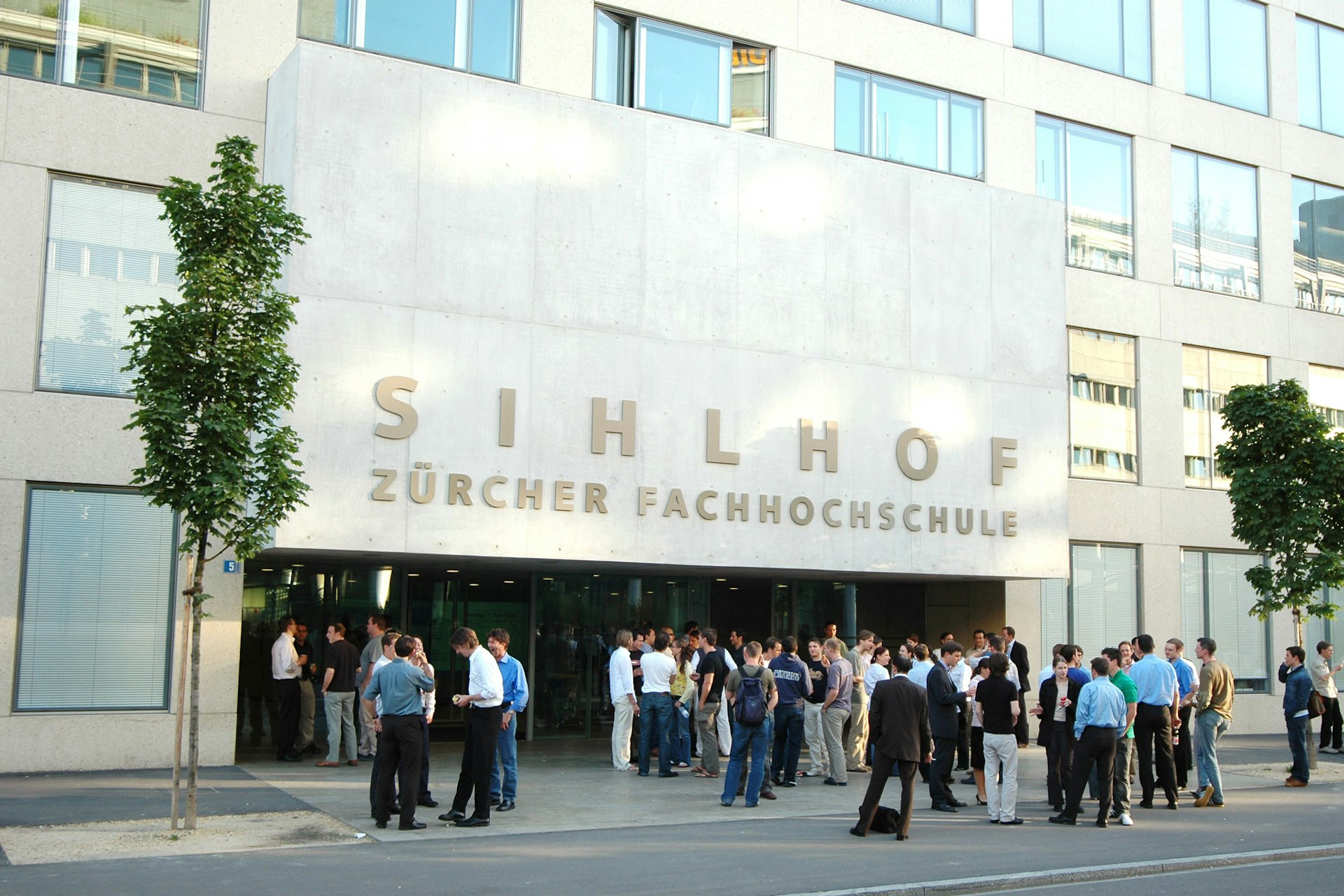
Seven universities of applied sciences as the new structure of Switzerland
A central element of the Universities of Applied Sciences Act was the restructuring of the educational landscape. In 1998, the Federal Council approved seven universities of applied sciences, initially only on a temporary basis until the end of 2003, which were organised on a regional basis. The aim was:
to bring together the previously fragmented landscape of higher technical colleges (HTL), higher schools of economics and administration (HWV), and higher colleges of design (HFG)
to create clear structures
to ensure international compatibility
These seven universities of applied sciences have established a reputation as practice-oriented, dynamic, and interdisciplinary institutions of higher education.
The transformation: from HWV to University of Applied Sciences
For the then part-time HWV – the predecessor institution of HWZ – this reform represented a profound transformation. The requirements were extensive:
Expansion into a university of applied sciences
Expansion of the performance mandate
structural integration into the new university of applied sciences system
HWZ responded early and strategically to these changes. In 1997, together with the Zurich School of Engineering, it founded the Zurich University of Applied Sciences for Technology, Business and Administration (HSZ). This established the organisational foundation required to meet the political requirements of the federal government and the canton of Zurich, which stipulated a certain size and several fields of study for recognition as a university of applied sciences.
In 1998, the Federal Council officially approved the new university of applied sciences. This made HWZ part of the newly established Swiss university of applied sciences system and granted it access to the Zurich university of applied sciences network.
In the years that followed, HWZ consistently developed its existing degree programmes. Curricula were revised, new quality standards were introduced, and additional areas of achievement such as Continuing education, applied Research and services. At the same time, the university professionalised its organisational structure and established new institutes and research centres.
In 2001, the transformation was completed with official federal recognition as a university of applied sciences. The part-time HWV thus became a fully-fledged university, with a clear focus on practical relevance, work-compatible study, and economic significance.
Practical relevance as a strategic response
While many institutions responded primarily with structural changes, HWZ used the reform strategically for positioning. It consistently focused on:
part-time degree programmes
Lecturers from industry
close collaboration with businesses
This focus was fully in line with the statutory mandate and became the key distinguishing feature.
Quality and accreditation: from aspiration to obligation
With the further development of the higher education system – particularly through the Swiss Higher Education Act (HEdA/HFKG, 2015) – quality has become a mandatory requirement.
The law required universities:
institutional accreditation
systematic quality assurance
transparent assessment of achievement
Preparation for the first institutional accreditation was therefore a process spanning several years. HWZ established systematic quality management processes, conducted internal evaluations, and had its structures and areas of performance reviewed externally. Even before this, the university had worked with the EFQM model and received several quality awards.
Successful accreditation was of central importance to HWZ: it not only officially confirmed its status as a recognised university, but also secured its long-term position within the Swiss higher education landscape. At the same time, it demonstrated that, as a private university, HWZ meets the same quality standards as state institutions.
Private yet systemically relevant
HWZ occupies a unique position within the university of applied sciences system:
organised under private law
without basic government funding
institutionally accredited under the Swiss Higher Education Act (HEdA/HFKG)
This combination enables:
high agility
entrepreneurial leadership
rapid adaptation to market needs
In this way, HWZ combines official state recognition with the dynamism of a market-oriented approach.
Conclusion: 40 years of HWZ – a story of adaptation and integrity
The development of HWZ is closely linked to the transformation of the Swiss higher education landscape. The Universities of Applied Sciences Act established the institutional framework within which new types of higher education institutions could emerge. For HWZ, however, this meant far more than a structural adjustment: it marked the starting point for a strategic realignment.
By addressing legal requirements at an early stage and consistently building upon them, HWZ developed a clear profile that balances practical relevance, close ties to industry, and academic standards. Its integration into the Zurich University of Applied Sciences strengthened its institutional foundation without compromising its entrepreneurial independence. At the same time, through the development of research, continuing education, and quality management, as well as successful accreditation, HWZ has demonstrated that it not only meets the demands of a modern higher education system, but also actively contributes to its ongoing development.
In its anniversary year, this becomes clear: The History of HWZ is a story of continuous adaptation – underpinned by a clear sense of purpose. A university that not only responds to change, but actively embraces it in order to continually redefine its role within Switzerland’s education and economic system.


FAQ
Federal Act of 1995 on the introduction of Universities of Applied Sciences.
International comparability and economic demand.
Expansion into a University of Applied Sciences with an extended remit.
Succession Act (2015) for coordination and quality assurance.
Sources & further information
Commemorative publication: 30 years of HWZ
Fedlex FHSG/HFGK: