Impulses for better leadership
How Antoinette Weibel has shaped HWZ and its leaders for 20 years
«We are off to a ride and it's gonna be bumpy.» With these words, Antoinette Weibel describes the future of leadership. For 20 years, she has supported students and executives at HWZ as a lecturer and has been actively involved in the university council. In this interview, the professor shares what makes the university special to her, reflects on her formative moments over the years, and discusses the skills and competencies that leaders will need in the future.
40 years of HWZ · July 22, 2026
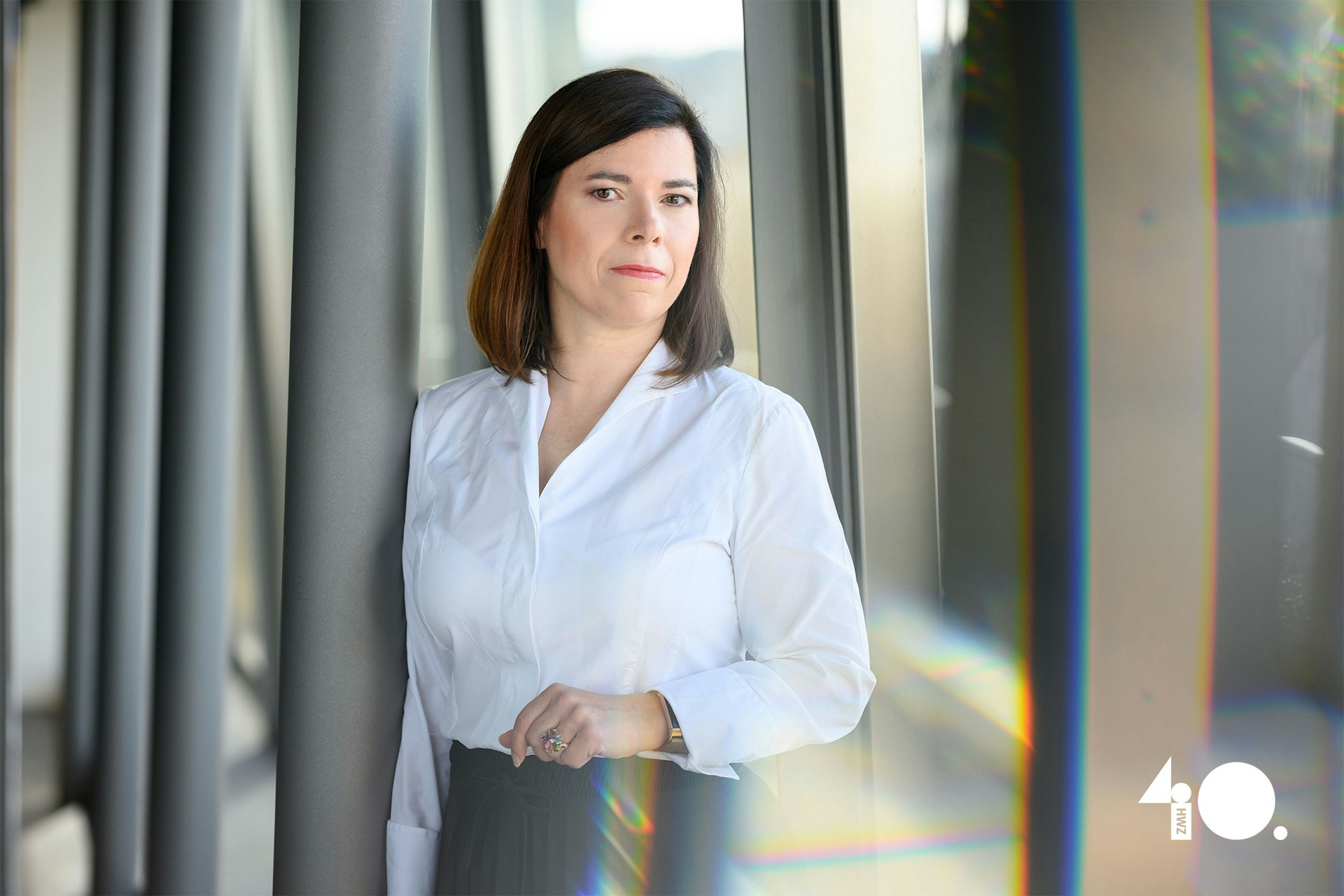
This article is part of the content series marking the 40th anniversary of HWZ. Through this series, we aim to showcase the diversity of stories from our university and highlight the topics and individuals that have shaped, and continue to shape, HWZ.
Since 2005, Antoinette Weibel has shaped HWZ as a lecturer on the EMBA General Management programme, as well as in various continuing education and degree programmes focusing on HR leadership, positive management, and organisational behaviour. She is also a member of the university council and contributes to the strategic development of the university.
As part of HWZ’s 40th anniversary celebrations, she reflects on two decades of encounters and practice-oriented continuing education, and explains in an interview why curiosity, empathy, reflection and critical thinking are among the most important leadership skills for the future.
20 years of commitment to HWZ
This year, HWZ is celebrating its 40th anniversary. At the same time, you have been teaching with us at HWZ for 20 years. What first brought you to HWZ back then, and why have you remained loyal to the university ever since?
My aim is to bring our research to the wider world. At the time, I was deeply engaged with the question of how companies can foster or undermine trust. And I admit: I still take a certain mischievous pleasure in dispelling myths and giving companies a bit of a wake-up call.
My aim is always to remind entrepreneurs and managers that a business is fundamentally a collective endeavour, and that a company can be more than just a profit-making machine.
HWZ has been open to this from the very beginning and is distinguished by its highly innovative, people-centred continuing education programmes. It is therefore enjoyable to create impact together.
Is there an encounter, a moment or an anecdote that has particularly stayed with you? :)
To be honest, it is almost always the encounters with students:
For example, the taxi company owner who, after attending the course, no longer tries to motivate his drivers with bonuses and finds that suddenly everyone is happier and more productive. When he told me about this, I was absolutely delighted.
Or the talented, inquisitive student in the introductory MSc course, who has since become a professor at HWZ himself. ;)
And of course, the intensive exchange with inspiring colleagues such as Martin Kägi and Dieter Schmid, with whom I have developed entire programmes from scratch.
A practice-oriented university environment
You have witnessed the development of HWZ over two decades. Which developments have had a particular impact on you, and what, in your view, distinguishes HWZ today?
I experience HWZ as a place where you can genuinely try things out. There are few blinkers, but a strong shared sense of purpose and spirit. To ensure this continues, the new chapter should not focus too heavily on competition. At heart, I am a professor at HSG and proud of my employer. Nevertheless, HWZ is a sparring partner for me, with whom I enjoy engaging. I do not see much value in a mindset of rivalry in this relationship. However, this approach must be embraced by all sides, and I very much hope it remains that way.
You are very familiar with both the academic and the practice-oriented higher education environments. What do you particularly value about working with professionals and experienced specialists and managers at HWZ?
HSG is also very practice-oriented. But in general, I would describe myself as an “engaged scholar”: interaction with practitioners is simply essential for me. What are the real problems and issues? How do practitioners solve them, how do we approach them, and how can we work together to develop better solutions? Where do obstacles arise, and why? All of this can be explored exceptionally well at HWZ together with the students.
Do you adapt your teaching depending on whether you are working with students at a university or with experienced professionals at HWZ?
Of course, I teach differently at undergraduate level. However, what I am truly passionate about is bringing practitioners and academics into dialogue with one another. I aim to do this primarily through discussion, by jointly exploring different perspectives and uncovering myths on both sides.
You know HWZ from various perspectives – as a lecturer, as a member of the university council, and as a research partner in joint projects. How do these different roles complement each other for you?
At HWZ, I primarily see myself as a lecturer. On the University of Applied Sciences council, I am something of a guardian of the differences: I bring the university perspective and ensure that the important distinctions between a university of applied sciences and a traditional university are maintained.
HWZ should continue to do what it does best: remain innovative and agile; we are happy to leave rigorous fundamental research to the universities. This is, after all, precisely what is envisaged in the Universities of Applied Sciences Act.
Key leadership skills
In your opinion, which skills will leaders particularly need in the coming years, and which would you like to impart to them in the EMBA General Management HWZ based on your many years of experience?
If I may offer some advice to students: work on developing your human intelligence and your character. Especially now, as the world is undergoing a major transformation—which of course also affects the world of business—we must, as people, approach shaping the future with solidarity, creativity, and a spirit of collaboration and shared thinking.
So, sharpen your empathy and critical thinking, embrace reflexivity (don’t always rush straight into action), and stay curious. «We are off to a ride and it's gonna be bumpy.»
When you think about the next ten years of HWZ: What should HWZ (also) be known for in the future?
It takes head, hand and heart, and at HWZ we engage all three.
More about the Executive MBA General Management HWZ
The part-time EMBA in General Management provides comprehensive management knowledge, combining academic foundations with a strong practical focus. Case studies and real-world issues are central to the programme.