Developments in Leadership Training
For the first time, more women than men are enrolled in leadership-oriented executive education at HWZ
While women remain underrepresented in leadership positions within the Swiss economy, a remarkable development can be observed at HWZ: for several years, the participation of women in leadership-oriented continuing education programmes has been increasing, and in 2025, for the first time, more women than men graduated from these courses. It remains to be seen whether this shift will in future also be reflected in the executive levels of companies.
Research · August 10, 2026
Women in the Swiss economy still take on leadership responsibilities less frequently than men. Recent studies – such as the Schilling Report or the Advance Study – show that significant differences still exist, particularly at the higher levels of the hierarchy. This makes it all the more interesting to look at the next generation of leaders.
The HWZ analysis shows that, for the first time in 2025, more women than men completed a leadership-related executive education programme at HWZ. This continues a trend that has been emerging for several years, indicating an increasing participation of women in leadership development programmes.
Key findings at a glance
The proportion of women in leadership-related executive education programmes at HWZ increased from 25 % in 2015 to 52 % in 2025.
In 2025, for the first time, more women than men completed a leadership-related executive education programme at HWZ.
The proportion of women in these programmes is now higher than the proportion of women across all HWZ degrees in undergraduate and executive education.
Compared to the Swiss labour market, HWZ also has a higher proportion of women in its leadership-related executive education programmes than is found in commercial professions with managerial responsibilities.
The trend demonstrates that executive education can make an important contribution to the development of future leaders.
For the first time, more women than men in executive education programmes
Over the past ten years, the proportion of women participating in leadership-related executive education programmes at HWZ has increased significantly. While it stood at around 25 % in 2015, it reached 52 % for the first time in 2025. At the same time, the number of female graduates rose from 10 to 91. As a result, for the first time, slightly more women than men completed a corresponding executive education programme at HWZ.
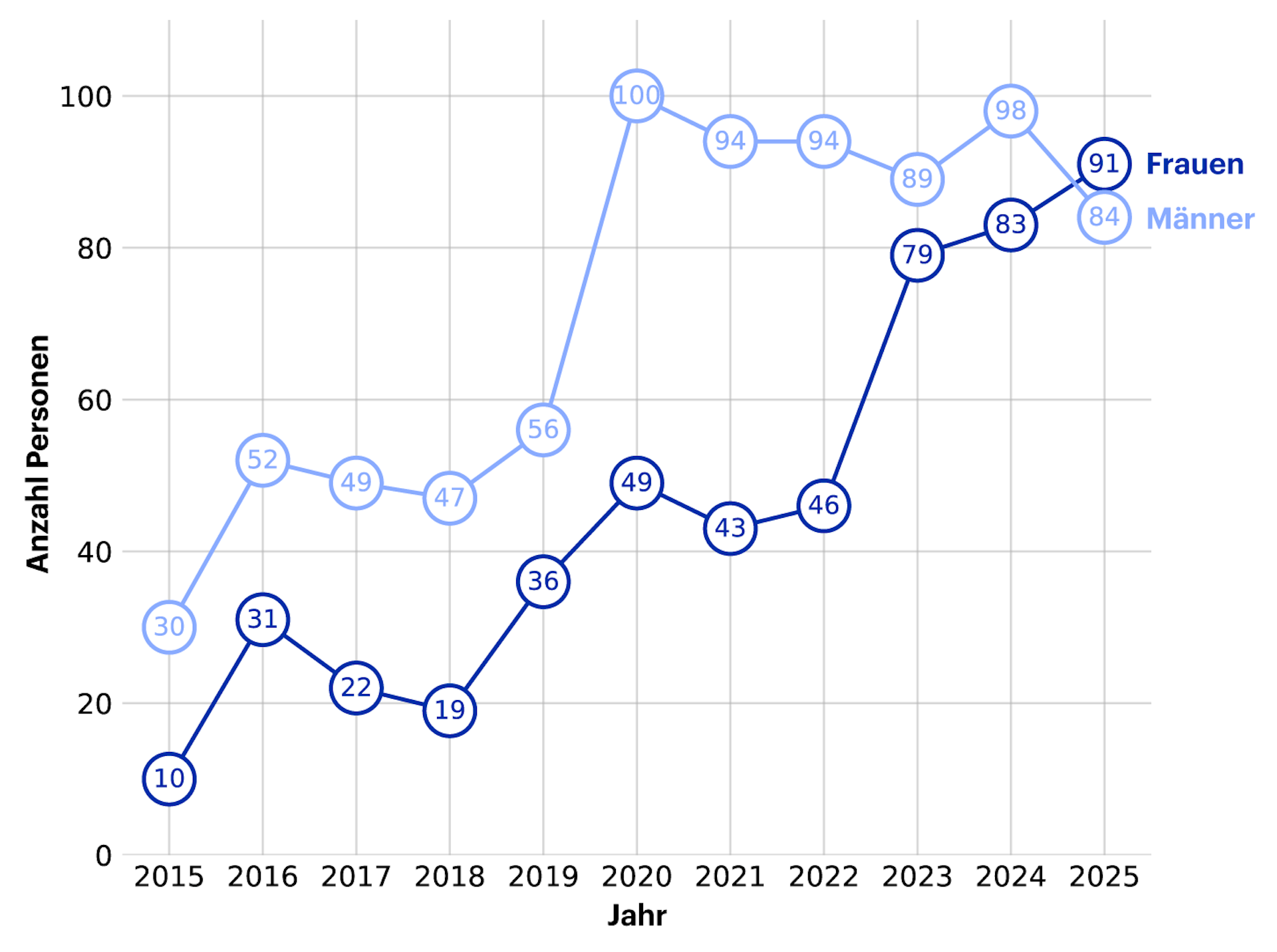
The figures indicate a continuous trend rather than a short-term fluctuation. Over several years, the proportion of female graduates has gradually approached that of their male counterparts and, in 2025, surpassed them for the first time, albeit narrowly.
Above the HWZ average and above the labour market
The development is also noteworthy when compared to other key figures. While the proportion of women across all HWZ degree and executive education programmes stood at 46 % in 2025, it had already reached 52 % in leadership-related executive education programmes. Women are therefore more strongly represented in these programmes than the average for all HWZ degree and executive education qualifications.
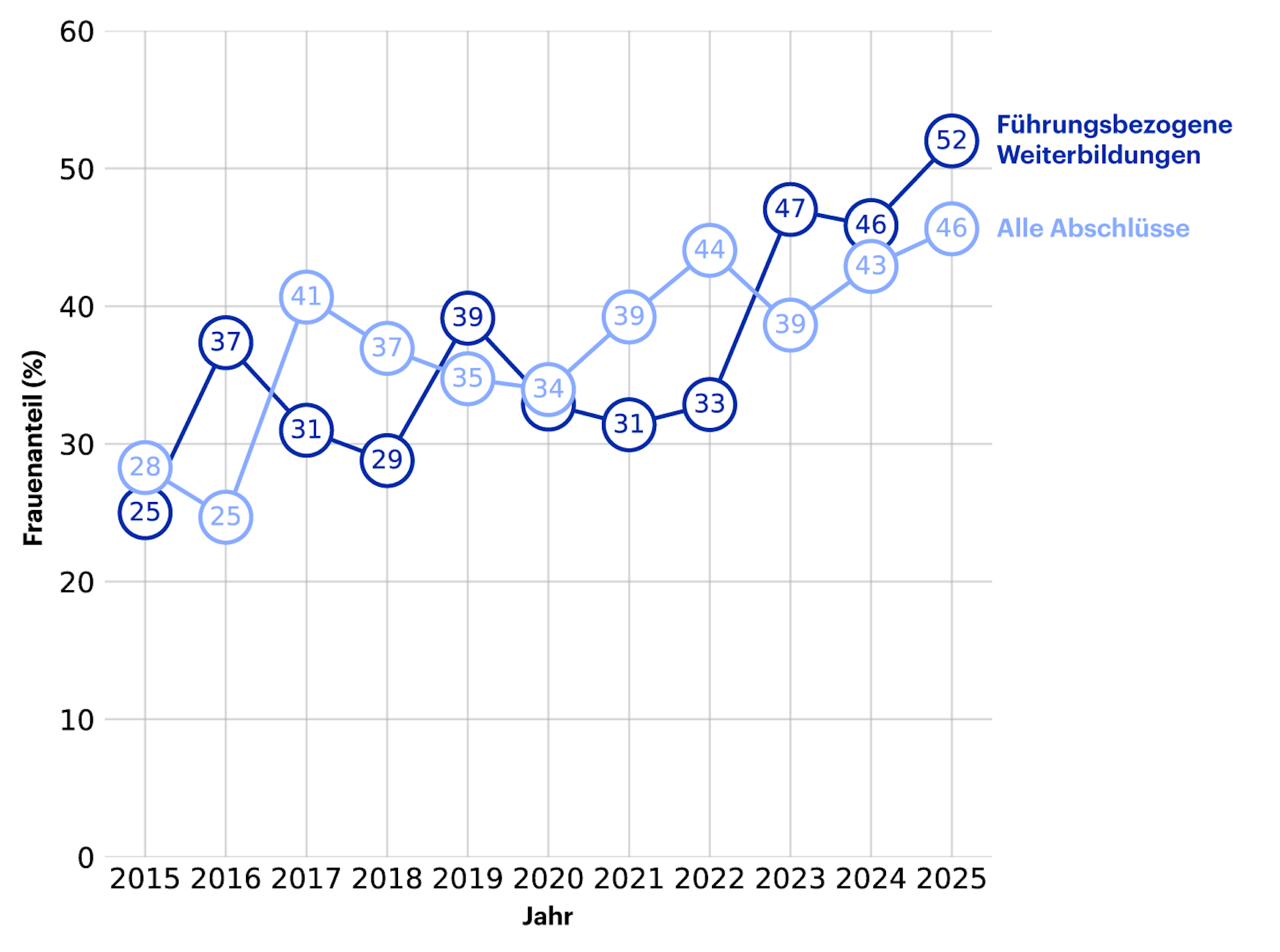
A similar picture emerges when compared with the Swiss labour market. According to the Federal Statistical Office, the proportion of women in commercial professions with managerial responsibility was 44 % in 2024. However, in leadership-related executive education programmes at HWZ, this proportion was already between 47 % and 52 %.
What the figures show – and what they do not
The analysis does not allow any conclusions to be drawn about how many female graduates actually go on to take up leadership positions. However, it does show that significantly more women are now actively preparing for leadership roles than was the case ten years ago. Executive education can therefore make an important contribution to expanding the pool of potential leaders.
The trend shows that an increasing number of women are actively investing in their leadership skills. While targeted executive education does not automatically result in more women in leadership positions, it is nevertheless an important prerequisite.

CAS Women Leading Digital HWZ
Start Jeweils im August
Duration 1 Semester

CAS High Impact Leadership HWZ
Start Jeweils im September
Duration 17 Tage

CAS Empowering Leadership HWZ
Start Jeweils im Oktober
Duration 16 Tage

CAS Leadership & AI HWZ
Start November
Duration 16 Tage
Why this development is relevant
The positive developments at HWZ contrast with a reality that remains different in many organisations.
Results of the Advance Study
A study conducted by the research team at HWZ on behalf of Advance shows that women remain significantly underrepresented in leadership and decision-making roles within Swiss SMEs. While gender distribution is largely balanced at non-management levels, the proportion of women decreases with each higher level of hierarchy. At the most senior management level, it stands at just 23 %.
The study also shows that structural and cultural factors continue to hinder the advancement of women into leadership positions.

Results of the Schillingreport 2026
A similar conclusion is reached by the Schillingreport 2026. The proportion of women on the executive boards of the largest Swiss companies stands at 22 %. At the same time, progress has recently slowed, and the share of new executive appointments filled by women has declined.
The figures from both studies make it clear that women remain significantly underrepresented in leadership and decision-making roles. This makes it all the more relevant to consider how the next generation is developing for future leadership positions.
Executive education as a contribution to the development of future leaders
As a university of applied sciences specialising in business, HWZ supports individuals in developing their skills and taking on leadership responsibilities. Executive education builds specialist knowledge, strengthens leadership abilities, and opens up new career opportunities.
The increasing participation of women in leadership-related executive education demonstrates that more and more women are actively pursuing this path. Although executive education alone does not guarantee balanced representation on management boards, it does provide an important foundation, enabling organisations to draw on a broader pool of qualified leaders in the future.
Outlook
The figures from HWZ reveal a clear shift among participants in leadership-related executive education. While women remain underrepresented in many management positions, more women than ever before are now actively preparing themselves for leadership roles.
To what extent this development will be reflected in the management bodies of companies in the future remains an intriguing question. What is clear, however, is that executive education plays a central role in this process.
Sources & further information
Internal HWZ Analysis of Leadership-Related Continuing Education 2015–2025
HWZ study: «How Swiss SMEs can better support women» (Advance)