


The Department of Management & Leadership
Lead mindfully. Act with values. Shape the future. The CAS Building Mindful Organizations at HWZ combines mindful leadership, sustainable organisational development, and entrepreneurial thinking. You will learn how to lead organisations successfully, with a focus on people and purpose—even in times of complexity and change. An exclusive highlight awaits you at the end of the programme: the Bhutan Field Week. On site, you will experience the unique concept of Gross National Happiness—an opportunity available to very few, which will have a lasting impact on your perspective of values-based leadership.
Apply
Generated with AI
Certificate of Advanced Studies (CAS) in Building Mindful Organisations HWZ
April 2027
CHF 12,500
16 days
February 2027
The language of instruction is German. Excellent command of English is essential.
Leading with clarity, responsibility and purpose
The CAS Building Mindful Organisations at HWZ is aimed at leaders who wish to shape organisations in a mindful, values-driven, people-centred and future-oriented manner. In times of increasing complexity, volatile markets and rising societal expectations, this programme equips participants with the skills to combine economic success with purpose, responsibility and sustainable impact.
Bhutan offers, through the state-anchored concept ofGross National Happiness (GNH)a globally unique reference model for integrating economic performance, governance, social well-being and ecological responsibility. GNH combines economic progress with societal well-being and long-term sustainability.
Collaboration with theRoyal University of Bhutan (RUB)and other Bhutanese institutions provides direct access to this practical expertise. It creates a credible space for experience and reflection, in which Western management and innovation approaches are meaningfully complemented.
The CAS Building Mindful Organisations builds upon HWZ’s longstanding collaboration with Bhutan, particularly on successful educational and entrepreneurship initiatives such as theBhutan Entrepreneurial Education Programme (BEEP)under the leadership of Dr Hugo Bigi. BEEP combines Swiss business expertise with Bhutan’s values-based development model, promoting entrepreneurial thinking in harmony with social responsibility and ecological balance.
This positions HWZ as one of the few European universities to offer values-based leadership education that is not only taught conceptually, but also institutionally embedded, delivered through experiential learning, and implemented internationally.
The CAS is aimed at experienced executives and decision-makers, managers and entrepreneurs, as well as HR and organisational development professionals, consultants and change agents who wish to actively shape culture, strategy and organisational development, and to drive the strategic advancement of their organisation.
This programme is aimed at individuals who wish to take responsibility for sustainable value creation and consciously practise values-based leadership within the dynamic interplay of people, the environment, the economy and purpose.
You will develop the ability to lead organisations with mindfulness, a values-based approach, and a focus on future viability. In doing so, you will learn:
Effectively applying mindfulness as a leadership and organisational competence
Strategically embedding principles such as people, planet, profit and purpose into leadership and business models
to build resilient, trust-based and values-driven organisational cultures
to make ethically sound decisions in complex environments
To combine inspiration from Bhutan with Western innovative strength and translate it into concrete transformation projects
The CAS Building Mindful Organisations HWZ combines mindfulness, values-based leadership, sustainability and entrepreneurial thinking into an integrated leadership approach.
The central question is how organisations can remain economically efficient while also being managed in a mindful, well-founded and focused manner, with a long-term and people-centred approach. In doing so, you consistently examine organisations from a systemic perspective.
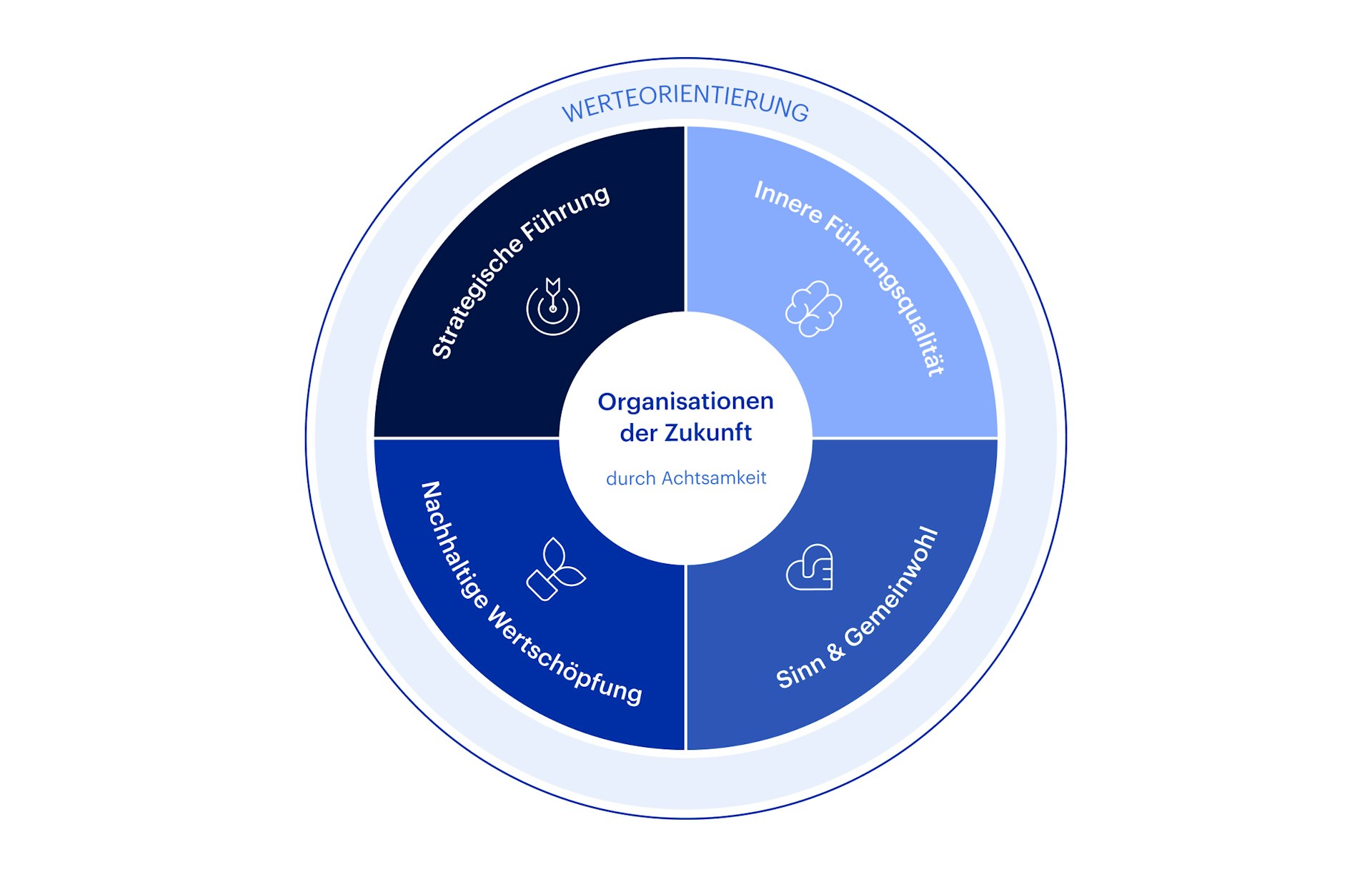
The degree programme is designed as a learning journey and is structured into seven interrelated modules. You will develop a solid conceptual foundation, deepen your leadership and management skills, and gradually apply your insights to your own professional context. A distinctive feature is the one-weekBhutan Field Experience, where you will experience the concept of Gross National Happiness (GNH) on site and critically reflect on it in relation to Western management approaches.
In the following modules, you will gradually develop skills in mindful leadership, sustainable organisational design, and entrepreneurial thinking.
Inner Transformation & Applied Mindfulness | 2 days
This module strengthens personal self-leadership as a foundation for effective leadership and collaboration. Participants develop a practical mindfulness practice, improve emotional regulation, focus, and resilience, and learn to recognise stress patterns at an early stage. Reflection, micro-practices, and transfer tasks ensure the application of these skills in both professional and personal life.
Sustainable & Responsible Leadership | 2 days
The focus is on mindful, people-centred leadership that combines performance with wellbeing. Participants will deepen skills such as active listening, empathetic communication, constructive feedback, conflict resolution, and psychological safety. This module translates these competencies into leadership routines for teams, change situations, and demanding stakeholder settings.
2 days
This module extends mindfulness from the individual level to encompass organisations and innovation. In the first part, participants analyse how structures, processes and culture shape the quality of collaboration, decision-making and workload, and develop concrete levers for creating a learning-oriented and responsible organisation. In the second part, they combine innovation methods with a mindful approach, focusing on curiosity, a willingness to experiment, and a values-based orientation. The module enables participants to diagnose organisational patterns, develop targeted interventions, and design innovation processes effectively, reflectively and sustainably, even under conditions of uncertainty.
2 days
This module combines financial logic, behavioural economics, and mindfulness to create an integrated approach to conscious decision-making. The focus is on how cognitive biases, emotional dynamics, and organisational frameworks shape financial decisions. Participants will gain an understanding of key biases (such as overconfidence and loss aversion), as well as the impact of uncertainty and pressure on decision-making. The module enables participants to approach financial decision processes with greater reflection and to develop responsible, long-term approaches to capital allocation within their own context.
Bhutan & Gross National Happiness – GNH | 1 day
This module introduces an alternative perspective on business ethics: value creation is defined not only by profit, but also by the common good, meaning, connectedness, and ecological boundaries. Using Bhutan’s Gross National Happiness (GNH) approach as a case study, participants reflect on the assumptions of modern economics and derive implications for leadership, organisation, and strategy. The aim is to develop a broader understanding of management that integrates long-term quality of life and sustainable development. In doing so, the module also specifically prepares participants for theBhutan Field Week (Module 6)before, in which these perspectives are at the origin of theGross National Happinessbecome directly tangible.
Bhutan Field Week | 5 days
Field Week is an intensive learning laboratory: participants experience context, culture, and practical examples first-hand in the Kingdom of Bhutan in the Himalayas, translating their observations into questions relevant to their own organisations and leadership roles. Through dialogue formats, site visits, reflection, and documented learnings, participants gain a deeper understanding of GNH-oriented development and mindful practice within systems. The focus is on experience, shifting perspectives, and developing concrete hypotheses for transfer.
Project work | 2 days
In the capstone module, the knowledge gained is applied to a concrete practical project – for example, as a concept, pilot, intervention or analysis within the participant’s own organisation or professional field. Participants define the target vision, benefits, stakeholders, approach and success criteria, and document the results in a transparent and comprehensible manner. The module concludes with a professional presentation of the outcomes and a clear roadmap for further development.
During the one-week Bhutan Field Experience, you will deliberately step outside your familiar leadership and organisational context and engage on site with alternative economic and societal perspectives.
Through direct engagement with experts and institutions, you will gain new perspectives on leadership, sustainability and economic value creation. This immersive experience enables you to challenge your own assumptions, broaden your outlook and take away valuable insights to support the ongoing development of your organisation.

To ensure that the insights gained during the CAS have a lasting impact, you will develop your own transformation project within your professional context over the entire duration of the programme.
You will apply the content of the CAS directly to your own organisation, reflect on your experiences together with faculty and peers, and develop concrete solutions. On the final day, you will present your project and discuss your findings in the plenary session.
The CAS Building Mindful Organisations is taught by experienced experts from both academia and professional practice. Among the lecturers are, among others:
Dr Hugo Bigi, CAS Programme Director & Principal Lecturer HWZ
Prof. Dr Antoinette Weibel, full professor of human resource management HSG
Diego Hangartner, PharmD, MCC Master Certified Coach, mindfulness trainer
Dr Bettina Hoffmann-Ripken, consultant and coach in transformation processes, HWZ lecturer
Dr Stefanie Hofer, neuroscientist, expert at Hirncoach AG
Costantino Lanni, Head of Studies Banking & Finance HWZ
Susanne Winkler, sustainability expert, lecturer at HWZ
Matthias Mölleney, international expert in HR management & lecturer at HWZ
Yvonne Seitz-Strittmatter, Head of HR, Ringier Medien Schweiz
Oliver Durrer, expert in organisational development and innovation, lecturer at HWZ
Pascal Joye, expert in positive leadership
The Bhutan Field Week is taught by leading mindfulness experts and experienced entrepreneurs from the Himalayan kingdom.
This CAS forms part of the following degree programmes.
University degree / higher qualification plus two Years of relevant professional experience following graduation. Other equivalent educational qualifications with corresponding practical experience may be recognised through a special admissions procedure.
Participation also requires leadership experience, a strong motivation for mindful transformation, and good command of English.
Any admission to one or more CAS programmes is generally independent of possible admission to the MAS. The latter is assessed separately as part of an admissions procedure.
Certificate of Advanced Studies (CAS) in Building Mindful Organisations HWZ
15 ECTS credits
The language of instruction at HWZ is German. Participation requires an excellent command of English, as certain content and the majority of exchanges during the Bhutan Field Week take place in English.
A one-week immersion module in Bhutan, enabling participants to experience GNH (Gross National Happiness) and Buddhist economics in practice.
Maximum of 25 participants
Reflection journals, practice-oriented assignments, group projects, and a final capstone presentation
Experience- and reflection-based learning through workshops, online collaboration, mindfulness practice, field studies and coaching. Mindfulness is an integral part of the programme, both in terms of content and methodology.
A university degree or higher qualification plus two years of relevant professional experience after graduation. Other equivalent educational qualifications with corresponding practical experience may be recognised through a special admissions procedure. In addition, participation requires leadership experience, a strong motivation for mindful transformation, and good command of English. Any admission to one or more CAS programmes is generally independent of possible admission to the MAS. The latter is assessed separately in a dedicated admissions process.
April 2027
February 2027
16 days including 5 days Bhutan immersion
Please refer to the attached study schedule for the exact dates.
Zurich; Sihlhof (directly by the main station) & Bhutan
CHF 12,500 The tuition fee covers all teaching days at HWZ as well as the costs for the visa, accommodation, and meals (breakfast, lunch, and dinner) during the Bhutan Field Week. The return flight is not included in the tuition fee.
Royal University of Bhutan (RUB)
We look forward to meeting you. We would be pleased to provide you with personal information about this degree programme.
The Department of Management & Leadership
Guest article by Lea Hungerbühler

Comparison of AI executive education programmes

How further education opens up new perspectives