Capstone Project 2024/25
AI-supported app to assist the fire brigade
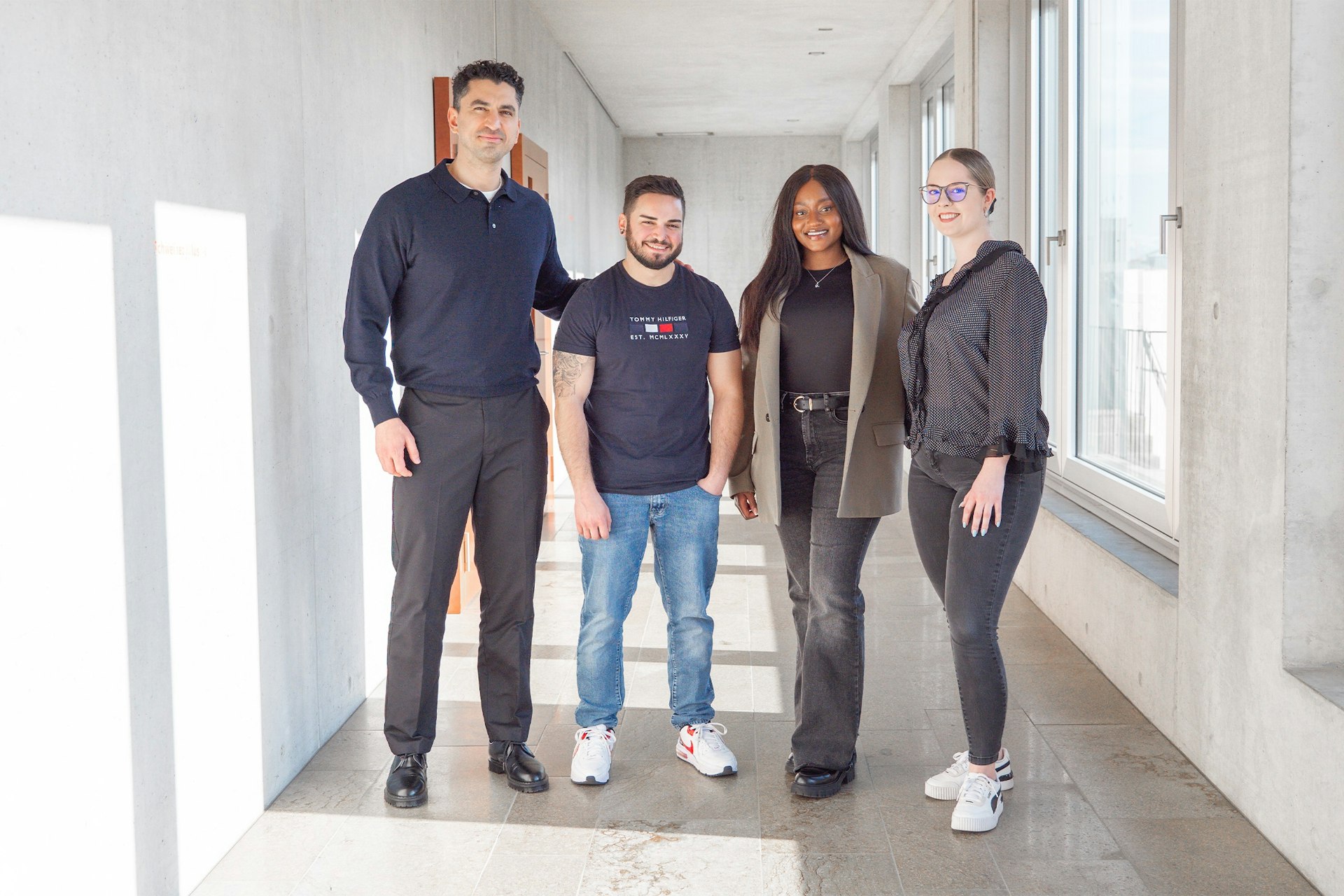
An emergency response with the fire brigade often begins with uncertainty. In the first five minutes of an operation, firefighters must act quickly and precisely—often without direct supervision, which can be highly challenging. This is where the winning team of the 2024/25 Capstone Project comes in: with their innovative app, “Emergency Assistant”, they aim to provide AI-supported assistance for emergency personnel, offering action recommendations for those crucial initial minutes. The following article provides deeper insights into the application developed by Andrea Alessio Da Cunha, Ilona Bakari Kapera, Larissa Chiara Burn, and Burak Necip Gündüz.
Campus · March 13, 2025
About the award
The Bachelor of Business Administration programme at HWZ is pleased to announce once again the impressive results of this year’s Capstone Project in the Bachelor of Business Economics. The programme is completed with the major in Digital Business & AI Management at HWZ. As part of this, students are tasked with developing a business case for the implementation of artificial intelligence within a company. Each year, the best project is recognised with a prestigious award.
Stress and uncertainty in the first five minutes
In the fire service, it is often unpredictable who will be the first to arrive at the scene. Incident commanders may be absent, and team leaders must act spontaneously and make decisions on the spot. For less experienced personnel in particular, the first few minutes of an operation are marked by uncertainty and stress. “For us, it was crucial to take away this fear and provide support,” explains a team member.
This is precisely where the solution developed by the winning team of this year’s Capstone Project in the Digital Business & AI Management major comes in. The four winners, Andrea Alessio Da Cunha, Ilona Bakari Kapera, Larissa Chiara Burn and Burak Necip Gündüz, have created an AI-based application that provides firefighters with targeted recommendations for action during the first five minutes of an operation. The idea arose from personal experience in the fire service: “I knew about this from my time in the fire brigade and made it the subject of my bachelor’s thesis. I looked into whether something like this was actually needed in the fire service. And yes, there is a gap here with real potential,” says Andrea Da Cunha.
Objective: Simple support through AI
The team aimed to develop an application that would support firefighters quickly and effectively, without overwhelming them. The goal was to use artificial intelligence to provide recommendations for action, thereby easing the burden on emergency personnel during the critical first minutes of an incident. It was important, the team emphasises, that the AI does not prescribe specific measures or make decisions about such emergencies, but merely offers guidance. In this way, the human remains in control of the crucial decisions.
The path to the solution
The development of the "Emergency Assistant" was an iterative process, accompanied by coaching sessions with Nino Weingart and Tony Kümin, lecturers in the Digital Business & AI Management major at HWZ. During these sessions, key issues such as liability and the role of AI were clarified. "It was important to us that the AI does not make decisions, but only provides support – responsibility remains with the human," explained a team member.
Andreas’s experience in the fire service provided the foundation that the team developed further together. The practical application of the AI knowledge gained during the degree programme was particularly exciting.
We were able to apply the knowledge we had acquired and gain an understanding of how such systems operate behind the scenes.
The team was united by a shared enthusiasm for technology, its diverse possibilities, and its potential in safety-critical areas. Step by step, this led to the development of a solution that combines practical relevance with technical innovation: the “Emergency Assistant” application.
The solution: an app as a digital deployment assistant
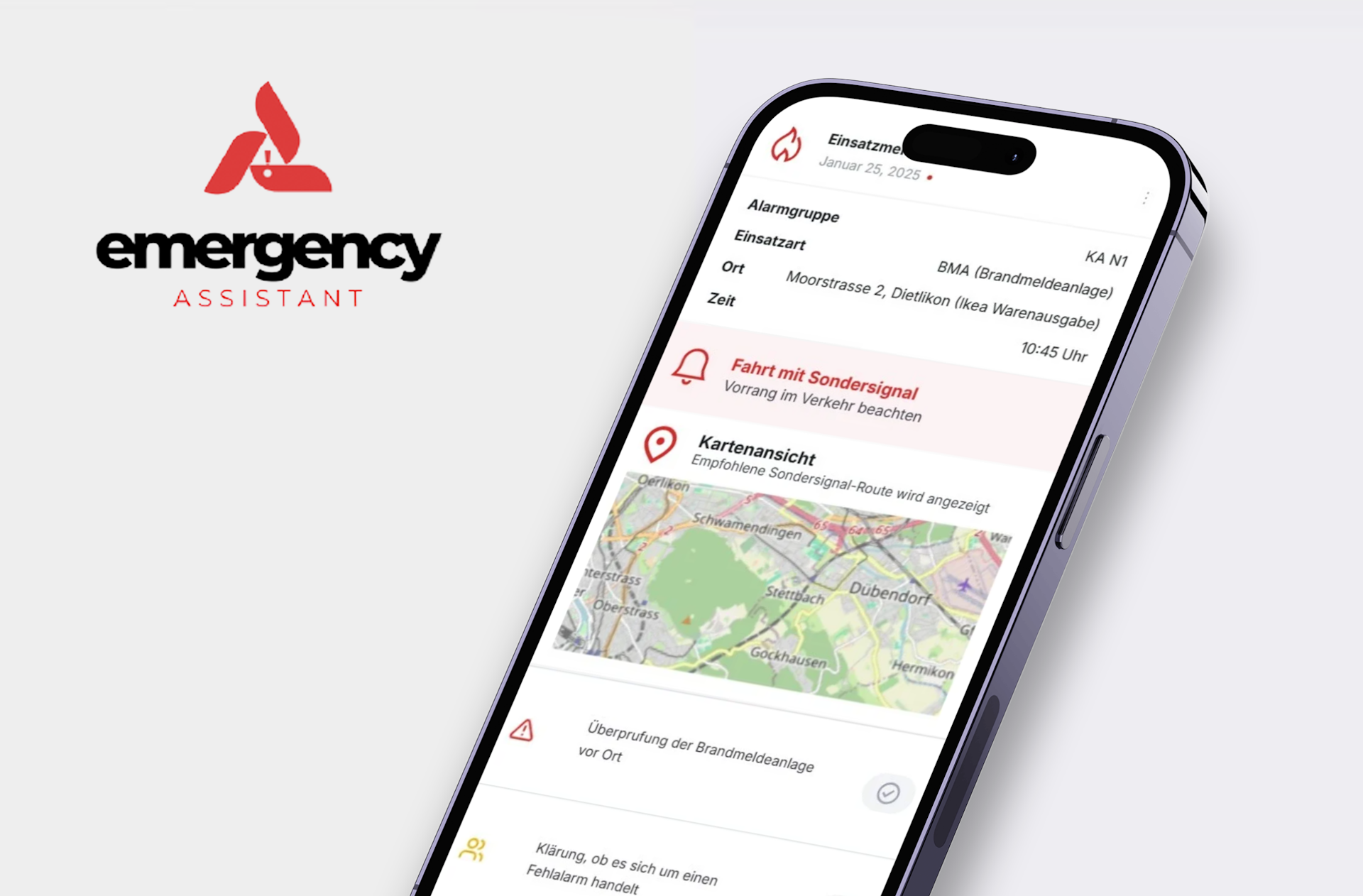
The developed “Emergency Assistant” is an AI-supported app that provides firefighters with recommended actions during the crucial first minutes of an operation. It combines incident reports—such as the location of the fire—with AI-generated suggestions based on historical deployment data and stored documents. The underlying technology employs two key AI methods:
The AI learns from past deployments and continuously adapts its recommendations. “The AI analyses how similar cases were handled and provides suggestions based on this,” explains a team member.
Relevant information is extracted directly from existing documents. “The fire brigade already has numerous incident reports, records, manuals and building documents stored on its servers. Our app can accept these PDFs via drag and drop, analyse them, and generate meaningful recommendations for action.”
The app has been deliberately designed with simplicity in mind: it provides concise, easily understandable text modules to avoid distracting firefighters. In future, the app could be enhanced with voice control to make operation even more intuitive and further minimise distraction. Additional scaling options include the automatic creation and recording of incident reports to simplify administrative tasks, as well as predictive analysis – using historical data to calculate the probabilities of possible scenarios.
The aim is for the app to provide support in the background without replacing the incident command.
The technology behind the "Emergency Assistant" is not limited to fire services. Other emergency response organisations, such as the police or ambulance services, could also benefit from AI-supported operational assistance.
Greatest lesson: creativity, curiosity and teamwork
Andrea, Ilona, Larissa and Burak particularly emphasise the importance of curiosity, creativity and team dynamics as central aspects in the process of problem-solving. “Our studies have shown us just how creative you can be, and that you should simply try things out!” said the team. The content and modules covered during the course supported this even further:
We were able to learn a bit of everything: AI technology, writing business plans, addressing legal issues, presentation skills – the entire programme prepared us perfectly for the capstone project.
Equally crucial to our success was the strong team dynamic and close collaboration: “We knew how each of us worked and could rely on one another. No one ever felt left behind.”
What are the next steps for the project?
Although the project team is not currently planning to establish a company, further development of the app remains a matter close to their hearts. Perhaps, one day, the "Emergency Assistant" will indeed reach the market. Until then, it continues to be an exciting experiment with great potential.