Bhutan Entrepreneurial Education Program
BEEP – an educational project with lasting impact
Through the Bhutan Entrepreneurial Education Programme (BEEP), HWZ brings Swiss business expertise to the Himalayan kingdom to promote sustainable business ideas. Dr Hugo Bigi, subject specialist and principal lecturer at HWZ, was on site as programme leader to plan the next steps with those responsible. We spoke with him to learn more about the programme and his impressions of Bhutan.
Campus · February 12, 2025

You can find the English translation of the interview below.
Hugo, you were recently in Bhutan. What brought you there?
Bhutan is a fascinating country—a Buddhist kingdom in the Himalayas with a unique economic and social philosophy. It is the world’s first CO₂-negative nation. I had the opportunity to hold discussions on site with government representatives, educational institutions, and entrepreneurs in order to gain a better understanding of the needs of the local economy. Particular attention was given to our new educational initiative, the Bhutan Entrepreneurial Education Programme (BEEP), which we are developing in collaboration with the Department for Employment and Entrepreneurship (DoEE) within the Ministry of Industry, Commerce and Employment (MoICE) in Bhutan. The purpose of my visit was to strengthen strategic partnerships and to prepare the next steps for the pilot phase of the programme, which will take place this summer.
What is the Bhutan Entrepreneurial Education Programme, or BEEP for short, all about?
BEEP is a strategic project of HWZ that aims to bring innovative entrepreneurial education to Bhutan, tailored to the country’s local circumstances and values.
Bhutan Entrepreneurial Education Programme

What makes BEEP unique is the combination of Swiss business expertise and Bhutanese culture, particularly the principles of Gross National Happiness. The programme is designed to enable Bhutanese entrepreneurs to develop sustainable business ideas and promote economic growth that is both socially and environmentally responsible. In doing so, we not only teach traditional business management skills, but also place a strong emphasis on innovation, digitalisation, and ethical entrepreneurship.
At the same time, BEEP provides valuable insights for HWZ and Switzerland: the experiences with sustainable entrepreneurship in Bhutan can serve as inspiration for local businesses, particularly in the areas of responsible business models, innovations oriented towards the common good, and long-term economic stability. The interplay between economic success and social responsibility in Bhutan highlights new perspectives that are becoming increasingly important within the Swiss economy.
This is not the first HWZ project in Bhutan. How did the idea arise to support Bhutan with Swiss expertise in education and business?
Exactly, our involvement in Bhutan began 16 years ago with theBhutan Middle Management Hotel Programme (BMMHP), which HWZ launched in collaboration with partners from the hotel industry. The successful programme, initiated by former HWZ Vice-Rector Urs Dürsteler, has impressively demonstrated that there is significant demand in Bhutan for practical and high-quality business education. The idea for BEEP arose from the need to extend this support to a broader entrepreneurial level. Bhutan faces the challenge of diversifying its economy – and this is precisely where HWZ can contribute its expertise. We see ourselves as bridge-builders between two worlds: on one side, Bhutan’s deeply rooted values; on the other, the knowledge and best practices of international business. We are convinced that, in the long term, both entrepreneurial communities – Bhutanese and Swiss – will benefit from this exchange.
Which core competencies does the programme provide to participants? And where do you place the greatest emphasis?
BEEP covers a wide range of entrepreneurial skills, including:
Business Strategy & InnovationHow can sustainable and successful business models be developed?
Marketing & Digital CommunicationHow can a company position itself in a rapidly evolving digital environment?
Finance & Investment PlanningHow does one finance a start-up or expand an existing business?
Management & LeadershipHow does one lead a team efficiently and responsibly?
Artificial Intelligence & Digital Business Models:How can the latest technology be used to unlock economic opportunities?
Our primary focus is on practical applicability: participants should be able to develop concrete business ideas through the knowledge they acquire and implement them with the support of mentors and experts.
Sustainability and social responsibility are deeply rooted in Buddhist Bhutan. How does BEEP integrate these values into business education?
Sustainability is of central importance to BEEP. Each module is designed to align with the values of Gross National Happiness (GNH). Specifically, this means:
Companies should not only generate economic profit, but also create social and environmental value.
Sustainability is presented not as a limitation, but as a competitive advantage.
The business ideas of the participants are assessed to determine whether they have a positive impact on society and the environment.
We are convinced that long-term economic success is only possible when it is aligned with the needs of society.
Gross National Happiness
Gross National Happiness sets Bhutan apart from all other countries. It is a holistic concept for measuring prosperity in Bhutan, going beyond purely economic indicators. This approach places the well-being of the population at its centre by taking into account not only material wealth, but also psychological well-being, social justice, and environmental sustainability. In doing so, it offers an alternative to conventional Gross National Income, which is based solely on financial flows.
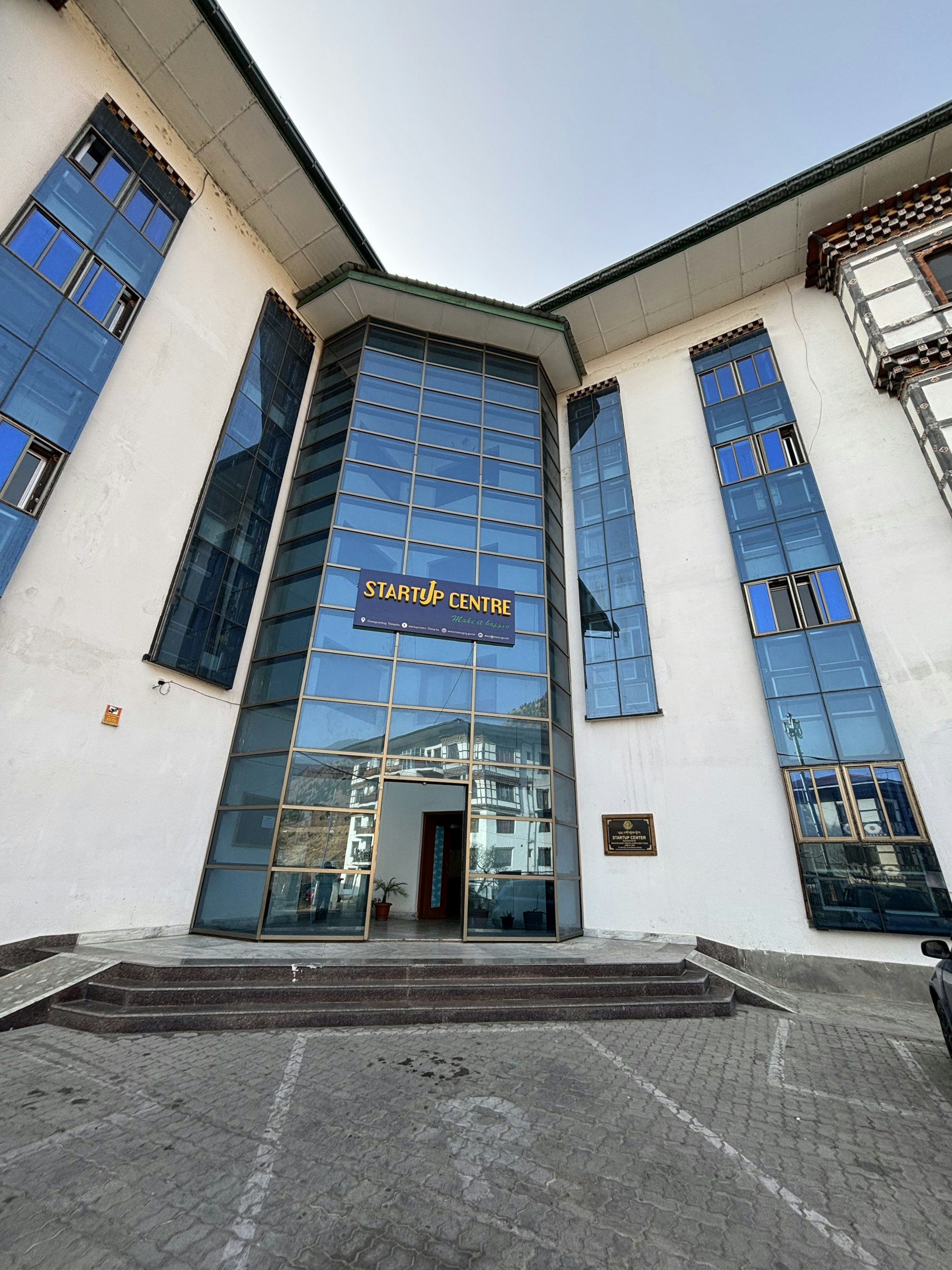
Collaboration with local partners is crucial. How does this work in practice – with the government, educational institutions, and local businesses?
Correct. Close collaboration with local stakeholders is essential for the success of the programme. We work closely with:
Government & Ministriesparticularly with the Department for Employment and Entrepreneurship (DoEE), to ensure that the programme is embedded within the national education strategy.
universities such as the Royal University of Bhutan (RUB) and other educational institutionsto ensure the long-term academic integration of the programme.
Local businesses & start-ups:to provide participants with realistic insights and practical learning opportunities.
The close partnership with local institutions ensures that BEEP is not merely an external educational project, but becomes an integral part of Bhutan’s economic development.
Such a programme requires support. How can interested parties from Switzerland or Europe get involved?
There are various ways to support BEEP:
Financial support:Funding for the development and implementation of innovative educational programmes, with the aim of establishing BEEP as a pioneering, internationally recognised training and continuing education programme in the field of entrepreneurship on a sustainable basis.
Partnerships:Companies can participate in Bhutanese start-ups as cooperation partners or investors via BEEP – either through direct financing or via a network of committed business representatives.
Mentoring & Knowledge Transfer:Experienced entrepreneurs and professionals can serve as mentors, sharing their expertise and proven best practices to provide targeted support to entrepreneurs and aspiring founders in our BEEP programmes.
Where do you see BEEP in five or ten years’ time? What are your long-term goals for the programme and for Bhutan’s economic development?
Our vision for BEEP is ambitious and long-term. In five years, BEEP aims to be established as the leading premium entrepreneurship programme in Bhutan. Through tailored courses, close links with teaching, continuing education and research at HWZ, an active alumni network, and successful start-up foundations, we seek to create a strong basis for entrepreneurial excellence.
Our ten-year goal is to establish BEEP as a permanent institution in Bhutan – an independent centre for innovative, practice-oriented entrepreneurial education with a broad international network. Bhutan has the potential to become a model for sustainable entrepreneurship. Through BEEP, we aim to foster this potential and build a bridge between Bhutan and Switzerland, in order to further develop entrepreneurial education and sustainable business practices on a global scale.
Bhutan Entrepreneurial Education Programme
Would you like to learn more about the HWZ educational project BEEP in Bhutan?